Autism Awareness Month. V is for Village

IMG_8068

Because we are so immersed in this world of autism I have erroneously concluded that everyone who lives outside of this Village is already aware of autism. However, there is a secret sorority that exists…one equipped with a secret handshake and password. I am in that sorority yet have no recollection of agreeing to join. Autism is funny like that. The Village of Autism parents is a unique one. We are a motley crew of individuals whose path may have never crossed otherwise. We meet each other in waiting rooms and lobbies of doctors offices instead of in the PTO. We have closed blogs and Facebook pages instead of casual phone calls. We learn more about the newest treatments and resources from each other than we do from professionals. We talk about how well our child is pooping quicker than we will discuss how well they are doing in school. Though we are typically the least able to, we are often the first responders to others in the Village because we are more likely to reach out to one another than we would outside of the Village where no one speaks our language. And we find each other….everywhere and all the time. Today while sitting on the floor in the middle of the children’s shoe department feverishly tearing inserts out of shoes and hopelessly attemping to shove A2’s newest orthotics into them with no success I broke down and cried. Just sat there in the middle of the floor, surrounded by ridiculous shoes with flashing lights on the soles and sobbed like a toddler might who couldn’t find the shoes she liked. At that same time, I peered up to see a woman pushing a cart with one hand while calmly using her other to push her much-too-large child who was humming loudly down back into his seat. We made eye contact for a single moment and silently nodded–her nod seemingly said “Yes….I know those orthotics were made wrong twice before in 7 months and represents 6 visits to the clinic over that same time. Yes…..I realize this is the 3rd store you have been in today that absolutely does not carry shoes your 9 year old can wear with the braces he must wear on his feet. Yes….I realize that your tears are really about your kid and the pain and blisters he will probably have again that he can’t communicate or the weird, white 1960s Frankenbaby shoes the orthotics company will recommend that look nothing like what his school friends will be wearing. Yes….I see you….and I know you see me….” V is for my Village. The quiet, connected Village where my family lives.


Day 21 Autism Awareness Month. U is for Ubiquinol

Day 21

U is for Ubiquinol

(originally posted 4/2015)

If you have heard this word before it is likely that you are either are a biologist or have a child with a mitochondrial disorder. In our case, to be sure….I am not a biologist. There is mounting evidence that autism and mitochondrial disorders at least co-exist in many cases. Mitochondria are organelles in almost every cell in the body and are considered the powerhouse of the cell. The mitochondria break down chemical compounds into energy and put it back into the cell for use. When there is a breakdown in the mitochondria factory, it cannot produce enough energy for the cell which can result in cell damage or death. This damage tends to affect larger organ systems such as the brain, heart, endocrine system, gastrointestinal system, kidneys and respiratory system. (As I mentioned….I am not a biologist..that’s about the best I can explain). The first time after 9th grade biology I heard about ATP or mitochondria was sitting in a neurologists office with A2 when she cocked her head and said “I need to send him to the Cleveland Clinic….I think he has mitochondrial disease…I am so sorry….”. I was confused–“Ok”, I said and left the office feeling optimistic that maybe we figured out why my baby completely stopped physically growing or gaining weight and developing. If we know what it is….we can treat it, why was she apologizing? But as it turns out, there is no cure and no real treatment for mitochondrial disorders. These disorders also tend to be progressive in nature so we must try to protect the mitochondria to the best of our ability using supplementation (thus the Ubiquinol CoQ-10) and body system balance. Under a microscope, A2’s mitochondria are oddly shaped..and there are a whole lot of them…and this hastened the question did some disease process or environmental assault cause this problem….or did he inherit it from me (mito are maternally inherited)? If something happened, what was it? Did I eat too many pesticides on my produce while nursing? Was his immune system down when he got a vaccination? Was the rated “F” water in Las Vegas where he was born full of toxins that damaged my baby? I am rational enough to know that there was nothing I could have done about my own mitochondria nor could I guess exactly what environmental assault would have caused such a huge problem…but it is here. And I now know why the neurologist apologized to me on that warm, blue skied summer day back in 2006…..

Autism Awareness Month. T is for Teachers and Therapists.

Day 20

 T is for Teachers and Therapists

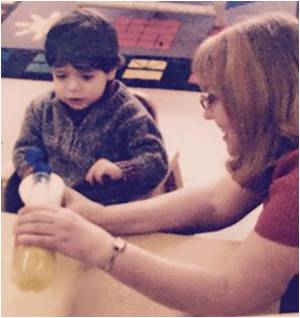
112. A2 has had a total of 112 different teachers and therapists in his short 11 years. Some were hand- picked….some chosen by fate and luck of the draw. Some were published…lauded recognizable names….some were quiet presences of whom I cannot remember their names. Some have been with us for the majority of his life. Some have only jumped in for a blip of time in his almost 105,000 hours on this planet. Some were stellar….life alterers….some just showed up because they had to. Some interpreted my coolness or seeming indifference to them as being non-caring. Some recognized that I always had my child’s best interest in mind all the time and understood it was important for me not to be too attached for fear of losing perspective and not holding them accountable should his learning derail. All have had a permanent impact on my entire family’s lives and for all of them, I am grateful.  When reading this post today–please help me help a few whose lives are difficult right now–Debbie Jo Pierce (pictured above) was one of the first paraprofessionals to work with A2. She has given most of her life to helping others and is ill with cancer leaving her unable to work and without income. Please consider today to donate to a Gofundme account started for her to help ease her burdens. Also, if you are of the praying sort, please like the FB page for Pray for Rachel. Lauren Sullivan, a favorite home team therapist of A2 15 year old sister Rachel is in Nationwide Children’s Hospital being treated for cancer. Rachel is her heart and soul –a child of strength and character. I am only one person–Christmas gifts and thank yous always seem so trite in the face of what we ask of the professionals who help us. Can you help make an impact for 2 of them today?

**This post has been updated since the original post  in April 2015, Debbie Jo passed away..taken too early in this world, yet someone must have felt her job here was done….and what a job she did in a quiet world where her time impacted so many.  Rachel Sullivan has made a full recovery and is enjoying school, family, sports and her community.

Autism Awareness Month. P is for Pediatrician

Day 16

P was hard because there are so many things P can be for us. Passion, Pediasure, potty training, poop, persistence (in a good way). But if this is about awareness, this is critical.

Early conversations over time had with doctors about both A1 and A2: Me: “He’s sitting up already but his hands are still in fists and he can’t grab anything-something doesn’t feel right. ”

Doc: “Wow. He’s just really uncoordinated.”

Me: “He can say way more than I think he understands-so I had a speech therapist look at him and she validated that, what is that?”

Doc: “That’s impossible. That therapist doesn’t know what she’s talking about.”

Me: “Since our move I’ve noticed he doesn’t babble in his crib any more and he only smiles at the microwave and the lamp, but not me.”

Doc: “You just moved…he’s getting used to his environment don’t worry about it (at 8 mos. old).”

I wish I could say that we just had a doctor who was incompetent  (and no, the picture is not of the ACTUAL doctor which would potentially explain how things would be missed), but I hear things just like this in my private practice all the time.

All. The Time.

If your gut feels off about something and you are dismissed by your pediatrician, get a second opinion. Seek out information online about early symptoms of autism. All the research points to early intervention as the key component to long term success with the symptoms of autism. There are programs that are now identifying autism in infants. Lack of eye contact, failure to meet developmental milestones (especially language), lack of responsiveness to their name, repetitive motions such as flicking hands in front of their face are just a few. Even outside of classic symptoms, there are some not so classic ones.

Both as a social worker, but also a mom, if you have a nagging gut feeling….”let’s wait and see if he grows out of it” may waste precious time.

Autism Awareness Month. O is for Obstinate.

Day 15

O is for Obstinate

All kids can be defiant. All kids can be persistent. Most can be both at one time or another…..however the persistence of a person with Autism can sometimes be far outside typical willfulness of even the most obstinate of kiddos. Most of this stems from intense need for familiarity, order and sameness of routine. This rigidity is part of the diagnostic criteria of Autism Spectrum Disorders. Sometimes I have no idea what will trigger A2 into a 3 hour long battle of wills. What can be a 5 minute routine one day can take 2 hours the next even when he knows that routine ends in something he enjoys. A1…no matter how much punishment, berating or time outs he got, he would get right back up and do the same thing over again. One summer I decided to ‘put my foot down’ and send him to the time out step after every single infraction.  No warnings.  That should teach him!  After about a week of this, there was a day that I had sent him 17 times all before my husband got home from work. And he went willingly. Every. Single. Time. Something was very wrong and thankfully I had a moment of clarity.  I got a clear cup, drew some lines across it and found a bag of marbles.  Every time I caught him doing the right thing, I would throw a marble in the cup with the caveat that he couldn’t point out to me how good he was being. Unless he hurt someone (which he never did), there was no more time out step. Every time we filled the cup to a line, he got to pick what we did next in our day.  If we got to the top (by the end of the day), he could get a dessert after dinner.

Just. Like. That. Everything was different. He would listen the first time and look out of the corner of his eye to see if I was digging for a marble. He got double marbles if he initiated social interactions. Before long, we were engaged in pretend play in the basement.

I had someone close ask “Don’t you think it might not be autism?  Don’t you think it is could be his personality?”.

“Well, ” I indulged “if everything we do serves a function, what function do you think his behavior served that week?”  Without much hesitation, she drew her hand up as if she was grabbing something and said “To have a ‘gotcha’ moment!” I thought for a moment.  “What 4 year-old would rather sit on a step over and over, day after day instead of playing just to get under his mother’s skin? Isn’t a week long enough to learn that without the behavior increasing?”  A four-year-old.  Clinically, that would be a much, much bigger issue than autism.

Before that, I used to joke about how even a dog can learn to salivate to the sound of a bell when paired with food over time, yet I could not get my child to understand how his behavior had anything to do with the consequence he would receive. It’s one of the most bewildering and frustrating parts of parenting because regular consequences do not work. Though A2 may connect consequence to behavior in the moment, the pathology outweighs all and it is likely that he may not learn from his behavior for the next time.  A2’s Childhood Apraxia of Speech required us to do drill work with cards for sounds and words over and over.  Did we create some of this rigidity with him because of this?  Probably.  Did I have any idea that would be possible then?  No. But the trade off was that he learned to try to speak and can make some needs known so that people other than me and my husband understand.  Was it worth it?  As a parent with limited understanding and resources  I would have to say “yes”, because he displayed rigidity before that.  Even as I add to this blog post from the original version written two years ago, I realize how much I have learned to even question if this was possible.  We have lots to continue to learn.

Autism Awareness Month. M is for Music

Day 13

M is for Music

In the presence of music, A2 is the conduit that paints the musical mural that you cannot see just by listening. It is a source of joy, excitement, passion and communication for him. Though A2 has a high desire to communicate his speech/language disorder makes it very difficult if not impossible sometimes to do so. A symptom of his Autism is Childhood Apraxia of Speech. Communication disorders that involve speech directly are a common issue for many children on the spectrum. A2 often knows what he wants to say, but cannot make his mouth follow the step by step instructions his brain wants him to in order to form sounds, sentences or ideas. This is a motor planning difficulty. There are phonological errors, jargoning and word finding problems and oral-motor weakness in addition that prohibit him from effectively communicating verbally. In addition to the 6 hours a week he receives of Speech therapy, Occupational therapy, Physical therapy and social skills training, A2 also receives Music therapy. Through music, he is learning how to say our names, his address and phone number. Music is his best friend, his motivator and his unique yet universal connection to everyone around him.

Autism Awareness Month 2015. K is for Kismet.

Day 11

In the month of our 15 year anniversary, I can confidently say we have embarked on a journey neither of us could have expected.

In some ways I wonder if our trek is easier than others since we never had musings of what our unborn children would be like or what kind of parents we would be.

…or if we would be parents at all….

I believe in a judicious balance between predestination and free will. Sort of like walking into a movie complex. You can pick the movie you will see, but once you choose it, the plot and ending remain the same. It is up to you if you decide to leave the theater to get popcorn or simply decide that movie is not for you and you should have never listened to Siskel and Ebert’s reviews to begin with.

All marriages require a gentle balance between cohesiveness and independence….and especially with families like ours. Stress is a constant, sleep deprivation a given, and child rearing? Well, throw out everything you ever thought you knew about that. Not everyone can do that.  Usually, the stronger is left holding the bag on their own.  I know too many families like that and watch in awe as the parent left behind carries the weight of her world.

Through thick and thin we give each other the space we need, recognizing we are in for the long haul.  Our children are who they are supposed to be.  We make the same mistakes as every other parent in every other union, but with the knowledge we must be united as forever parents, even long after we are gone.  And for that, perhaps we are luckier than most.

Autism Awareness. Day 5 E is for Elopement

Day 5

E is for Elopement

“Check water first”. The most terrifying emergency directive a parent can hear….and this is the protocol for children with Autism who go missing. Elopement, wandering, bolting, fleeing. 48% of children with autism elope. Drowning is the leading cause of death in kids under 14 with Autism. We are lucky-A2 only gets distracted and wanders to find things that are interesting without regard to safety or whether a familiar adult is nearby–but he does not run from us–which prevents so many families from being able to go in public safely with their child. One of the things that makes A2’s non-elopement complicated as that he is not a risk…. until he is.  He can go a full year with staying in eye shot and then one day out of no where he will simply leave the house. With no warning. He also cannot tell anyone his first and last name with consistency or clarity.  He does not know his address or phone number despite years of practice.  He knows my full name, but unless you are a trained listener. you will not understand him.  We all know to approach a young child who appears to be lost, but most would not think to approach an older child or young adult. Be aware–this is one way we can all be a village to our families!

Unfortunately, there are limited ways to actually prevent elopement behaviors.  When we assume the function of behavior is escape we may be missing out on other factors.  Does he bolt and laugh while doing it as he watches you chase him (attention)?  Is he fascinated with streetlamps or water or heavy equipment and feels intense compulsion to go check it out (access or internal attenuation)?  Does he seem to leave only in specific situations or with specific people?  If you have a child that is a runner, consider tracking the behavior for antecedents and response or consequence (even when unintended), track the time of day and what was happening around him at the time.  Track WHAT the elopement looks like…does he run or is it more like walking away?  Does it change what it looks like based on the situation?  Besides lockdown and direct supervision, understanding your child’s behavior through data collection is your best preventative defense.

As far as what else you can do if your child is an elopement risk…again, limited but both high and low technology options can be lifesavers. If your county or police department have a special needs registry, register your child. There is a national initiative and grant called Project Lifesaver that your police department can utilize and get wristbands with gps or radio signal your child can wear. Keep an up to date photo of him on you at all times. Create a card he can carry with him with his information and use discrete trial training to teach him to hand it to someone if he cannot find you. Consider a cell phone and GPS tracking or the Find My iPhone App. There are tracking devices like http://www.angelsense.com available for a monthly fee. These attach to the inside of clothing.  Go online and search for other high and low tech options they are out there.

GPS tracking device reviews:  http://www.safewise.com

List of tracking, ID and safety products (not an exhaustive or all inclusive list): https://www.autismspeaks.org/family-services/resource-library/safety-products

It is easy not to move forward because we do not want to assume the worst…..but like for so many of us in many aspects of our lives with our kiddos…we have hope for the best…but plan for the worst.


Day 3 2015. C is for Coping

Day 3

In the most typical of situations sibling issues exist. For sibs of those with significant impairment, these kids are often the invisible bystanders. Their issues and needs sometimes take backseat to the immediacy and reality of their sibling with Autism needs. We ask them to deal with leaving fun events earlier than they would like, let embarrassing situations roll off their backs and stifle disappointment. The rate of having more than one child with neuro diversity is high. Sometimes, the less impaired child is asked to cope and step up in ways that would challenge even the most typical and mature of children.

Day 1. A is for Aides

Day 1

A is for Aides.

Though I can’t find pictures of all of them, they have all made a significant impact in our lives. Without them, A2 would not have made the gains in language, socialization and self care that he has. They have cleaned vomit out of their cars, do not ruffle at the idea of diaper changes, and have endured power struggles with grace and maturity. They are the extra eyes and hands in a world where we have none but need 20. They are young and move on with their lives from us but we have always known that we sacrifice longevity for love and are happy that so many reach out to stay part of our village.