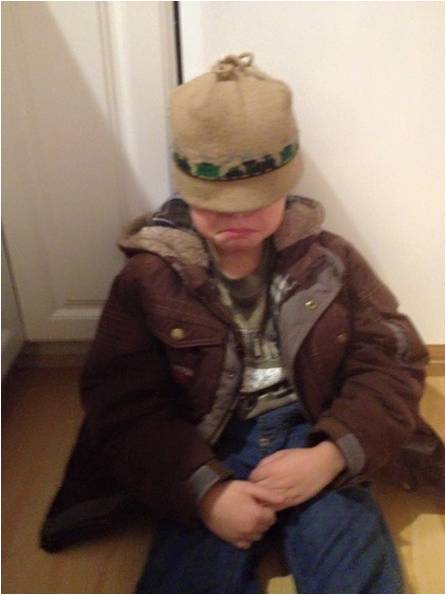
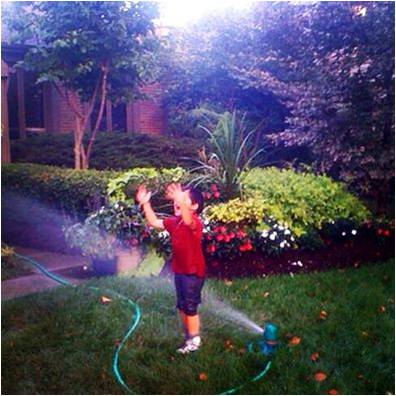
“Why does he do that?” A common question for parents of children with autism. There is no easy answer for that in a global sense given each child with autism is as unique as any child without autism. Many times it’s because the wires are crossed neurologically causing some kids like A2 to perceive things in the world differently. Licking a basketball before he shoots it, flapping his arms whenever he is excited or anxious or hooting loudly when he sees something interesting….try thinking instead taste sometimes is like balance, repetitive movements are calming to the body and noise is quicker that coming up with words. Sometimes the quirk comes because the part of the brain responsible for things like memory, the time it takes to process information and the ability to take another persons’ perspective has a blip and experiences the world in the same way much like A1. Someone just said to me “I always thought he just marches to the beat of his own drummer”. And he does. They both do. My kids are as they are and as they should be but at the same time they do need to be functioning and hopefully contributing members of society. Sometimes though, to watch the struggle of loneliness because others don’t understand is painful and hope that I am projecting my own anxiety and that they are more resilient than I give credit for. This unique and quirky nature of autism makes my guys who they are…..and they are perfect to me. Perfect…and different, not less….
Apraxia
Autism Awareness Month. O is for Obstinate.
O is for Obstinate
All kids can be defiant. All kids can be persistent. Most can be both at one time or another…..however the persistence of a person with Autism can sometimes be far outside typical willfulness of even the most obstinate of kiddos. Most of this stems from intense need for familiarity, order and sameness of routine. This rigidity is part of the diagnostic criteria of Autism Spectrum Disorders. Sometimes I have no idea what will trigger A2 into a 3 hour long battle of wills. What can be a 5 minute routine one day can take 2 hours the next even when he knows that routine ends in something he enjoys. A1…no matter how much punishment, berating or time outs he got, he would get right back up and do the same thing over again. One summer I decided to ‘put my foot down’ and send him to the time out step after every single infraction. No warnings. That should teach him! After about a week of this, there was a day that I had sent him 17 times all before my husband got home from work. And he went willingly. Every. Single. Time. Something was very wrong and thankfully I had a moment of clarity. I got a clear cup, drew some lines across it and found a bag of marbles. Every time I caught him doing the right thing, I would throw a marble in the cup with the caveat that he couldn’t point out to me how good he was being. Unless he hurt someone (which he never did), there was no more time out step. Every time we filled the cup to a line, he got to pick what we did next in our day. If we got to the top (by the end of the day), he could get a dessert after dinner.
Just. Like. That. Everything was different. He would listen the first time and look out of the corner of his eye to see if I was digging for a marble. He got double marbles if he initiated social interactions. Before long, we were engaged in pretend play in the basement.
I had someone close ask “Don’t you think it might not be autism? Don’t you think it is could be his personality?”.
“Well, ” I indulged “if everything we do serves a function, what function do you think his behavior served that week?” Without much hesitation, she drew her hand up as if she was grabbing something and said “To have a ‘gotcha’ moment!” I thought for a moment. “What 4 year-old would rather sit on a step over and over, day after day instead of playing just to get under his mother’s skin? Isn’t a week long enough to learn that without the behavior increasing?” A four-year-old. Clinically, that would be a much, much bigger issue than autism.
Before that, I used to joke about how even a dog can learn to salivate to the sound of a bell when paired with food over time, yet I could not get my child to understand how his behavior had anything to do with the consequence he would receive. It’s one of the most bewildering and frustrating parts of parenting because regular consequences do not work. Though A2 may connect consequence to behavior in the moment, the pathology outweighs all and it is likely that he may not learn from his behavior for the next time. A2’s Childhood Apraxia of Speech required us to do drill work with cards for sounds and words over and over. Did we create some of this rigidity with him because of this? Probably. Did I have any idea that would be possible then? No. But the trade off was that he learned to try to speak and can make some needs known so that people other than me and my husband understand. Was it worth it? As a parent with limited understanding and resources I would have to say “yes”, because he displayed rigidity before that. Even as I add to this blog post from the original version written two years ago, I realize how much I have learned to even question if this was possible. We have lots to continue to learn.
Autism Awareness Month. M is for Music
M is for Music
In the presence of music, A2 is the conduit that paints the musical mural that you cannot see just by listening. It is a source of joy, excitement, passion and communication for him. Though A2 has a high desire to communicate his speech/language disorder makes it very difficult if not impossible sometimes to do so. A symptom of his Autism is Childhood Apraxia of Speech. Communication disorders that involve speech directly are a common issue for many children on the spectrum. A2 often knows what he wants to say, but cannot make his mouth follow the step by step instructions his brain wants him to in order to form sounds, sentences or ideas. This is a motor planning difficulty. There are phonological errors, jargoning and word finding problems and oral-motor weakness in addition that prohibit him from effectively communicating verbally. In addition to the 6 hours a week he receives of Speech therapy, Occupational therapy, Physical therapy and social skills training, A2 also receives Music therapy. Through music, he is learning how to say our names, his address and phone number. Music is his best friend, his motivator and his unique yet universal connection to everyone around him.
Autism Awareness Month 2015. K is for Kismet.
In the month of our 15 year anniversary, I can confidently say we have embarked on a journey neither of us could have expected.
In some ways I wonder if our trek is easier than others since we never had musings of what our unborn children would be like or what kind of parents we would be.
…or if we would be parents at all….
I believe in a judicious balance between predestination and free will. Sort of like walking into a movie complex. You can pick the movie you will see, but once you choose it, the plot and ending remain the same. It is up to you if you decide to leave the theater to get popcorn or simply decide that movie is not for you and you should have never listened to Siskel and Ebert’s reviews to begin with.
All marriages require a gentle balance between cohesiveness and independence….and especially with families like ours. Stress is a constant, sleep deprivation a given, and child rearing? Well, throw out everything you ever thought you knew about that. Not everyone can do that. Usually, the stronger is left holding the bag on their own. I know too many families like that and watch in awe as the parent left behind carries the weight of her world.
Through thick and thin we give each other the space we need, recognizing we are in for the long haul. Our children are who they are supposed to be. We make the same mistakes as every other parent in every other union, but with the knowledge we must be united as forever parents, even long after we are gone. And for that, perhaps we are luckier than most.
Autism Awareness Month 2015. J is for Joy.
Day 1. A is for Aides

A is for Aides.
Though I can’t find pictures of all of them, they have all made a significant impact in our lives. Without them, A2 would not have made the gains in language, socialization and self care that he has. They have cleaned vomit out of their cars, do not ruffle at the idea of diaper changes, and have endured power struggles with grace and maturity. They are the extra eyes and hands in a world where we have none but need 20. They are young and move on with their lives from us but we have always known that we sacrifice longevity for love and are happy that so many reach out to stay part of our village.
B is for Boredom: 2015 Autism Awareness Month

While A2 is the most fun loving, joyous person you will ever meet and lovess to be on the go–like many children with Autism he struggles with extreme boredom since he requires adult intervention to choose, initiate and maintain activities. His explicit expression of wanting to play with other kids is emerging but often it leaves him alone knocking on the back door window as he watches children playing unsupervised across the street.