The Grim Reaper takes a break to ensure his safety while the ill-prepared firefighter keeps his distance just in case
Though Halloween parties have turned into “Harvest Parties” at school, the anticipation and sentiment of Halloween is still timeless. As a parent I find myself still caught up in Halloween and creating spooky Pinterest fails and contemplating what candy I can pilfer from my child’s treat bag without him noticing. Some costumes are so realistically scary that I am not certain that my red meat consumption hasn’t finally caught up with me and am opening my door to the actual Grim Reaper himself. There is a revolving door of Elsas and Ninja Turtles who could just very likely just be the same child over and over again capitalizing on those homes who everyone knows passes out full sized candy bars.
A couple of years ago I was coordinating a party for my child’s 4th grade classroom. 20% of that classroom had food allergies. I gently reminded parents that the goal was for all our children to be included, be safe and have fun. I was perplexed when one parent refused to change the cookie decorating idea she had. “Kids who can’t make or eat them can at least enjoy them for how cute they are”. In what I believed was a teachable moment I reminded her that it still excluded them and also created a potentially dangerous situation. This parent became so incensed that she quit the committee. While I still get as excited about Halloween as the next guy, I was horrified as one of those children was mine….and another parent was willing to not only exclude him, but risk his safety because she was so excited about her adorable witch hat cookie project.
Halloween has become the holiday where those children with differences become the most exposed and have the potential to be the most left out. The numbers of children with food allergies and other differences have risen sharply since I was a child. As a parent with kids with food issues and also autism, it took me many years to figure out ways how to adapt the most super-fun holiday so it was still fun. Turns out, there are lots of ways to do this both as parents and as community members.
Here are some of the top ideas for the “BIG 3” to make Halloween still the coolest holiday ever 1. FOOD ALLERGIES:
a. PARENTS: Sort out the candy together so you can help teach him what is ok to eat. Have the “SWITCH WITCH” visit later that night and exchange that bag of candy full of offending allergens with a present. Your child will be thrilled to have the best of both worlds. And hey, there is no rule that says the switch witch can’t give you that bag to stash away and secretly eat after the kids are asleep.
b. SUPPORTERS: The Teal Pumpkin project is a new idea sweeping through social media. If you paint a pumpkin teal and have it on your front porch it will alert parents of kids with food allergies that you have an allergen alternative available. Also, for class parties, ASK about allergens—be sure to ask about brand specifics and preparation—that can all play a role in safety. Please remember what it would be like to be 8 years old where everyone gets to eat really cool looking cupcakes except for you. If that were easy to do, none of us would ever be on a diet. The willpower of a child with a food allergy is like nothing most of us can ever understand.
2. SENSORY DIFFERENCES:
a. PARENTS: Respect your child’s sensory difference. If noise is an issue, avoid those homes that go all out for Halloween….your child might be in for a “jump scare” that will end his evening of fun. Costumes are not always made out of the finest of materials.have him choose his own and try a number of options until one feels right. Contact your local support groups for special needs—there may be sensitive Trunk or Treat nights available which may suit your child much better.
b. SUPPORTERS: Teachers and room parents—if you have children with special needs in your class, tone down the scary a bit. Spooky music should not be on full blast and the mulling around of 25 kids in costume might be disorienting. Have a quiet space outside of the classroom where the child knows he can go to escape if overwhelmed. And for pete’s sake NO BALLOON POPPING ACTIVITIES OR STROBE LIGHTS!
3. AUTISM:
a. PARENTS: Create visuals to help your child understand what to expect at school parties or trick or treat. Try on the costume ahead of time. If your child does not want to participate in Halloween festivities, don’t force them. Throw a small party at your house with old school fun and invite 2 or 3 children he knows for trick or treating, stick to familiar neighbors homes buddy up with a child who can model. Sometimes “just a hat” IS a costume with enough thinking on the fly.
Freddy Krueger as a child…before all the drama. He just wanted to feed everyone cereal and soup.
b. SUPPORTERS: If a child does not say “trick or treat” or “ thank-you” he may not be being rude. He may not be able to speak or fully understand what is expected of him. Same goes for a child who appears too large or too old for trick or treating. If a child grabs a handful of candy or doesn’t seem to know what to do when you hold the bowl out, give them a prompt of what to do or physically help them. Their fine motor skills may be impaired and the ability to just pick one or two candies from a dish might be difficult. Still compliment an aspect of their costume even if it seems incomplete. This is still their Halloween too!
Those of us who try to make our kids feel included no matter what can get very good at scooping up the world around, tying it in a different bow and re-presenting it to our kids and Halloween is no different. With the help of our community, little tweaks can make all the difference between Halloween being fun or being truly scary.
Every few years, I go on a life sabbatical. Life sabbaticals work differently than educational sabbaticals mostly because they are not real. The notion that there are people who receive paid time to disappear somewhere to have a temporary life that doubles as a say-no-more way to avoid other social responsibility is magical. “No, no, I won’t be here to chair that research project, I will be away on sabbatical.” versus “Well…you’ll just have to have that IEP meeting for my kid without me, I’ll be on life sabbatical. Have your people call my people” doesn’t quite have the same heady ring to it and might necessitate a call to a mental health professional.
Unlike our neurotypical cohorts, many of us special needs parents are preparing for a forever life. Though we feverishly plan for it, there might not be a high school graduation send off party unless of course that party is sending off what few resource and assistance waivers our children got before they age out of the system. Diapers and tantrums are likely going to get larger. With the passage of time I am already finding myself getting smaller, more tired and more complacent in the frenetic searching, learning and advocating as certain realities set in. This is troubling.
Apathy is the ugly stepsister of passion. While passion will gladly cut off a chunk of heel to make her foot fit into that glass slipper in hopes of a prince, apathy will do so because its easier to make do than to shop for something to wear to the ball.
Endless details and inconveniences are just part of daily life in parenting regardless of circumstance. Its like the service charge for the privilege of parenthood and an occasional break from that is necessary for even the strongest of mommy constitutions. However, there are those of us who are so steeped in the present at all times where there are rarely idle moments not spent trouble shooting, even in the middle of night as we play musical beds and double-check doors. So I am mindful in the moment and I am mindful in that moment contemplated 30 years from now. The whispers of all the things that will come in between need to shut the hell up because I simply have no room at the inn left to consider those things.
As caregivers we are told to take care of ourselves, take time off, do what we love. This seems like cheap advice and when heeded I am reminded that ultimately not much is different on my return. The airline may have lost my tagged luggage of anxiety while I was away, but it is surely taking a circular ride on the carousel at gate 6 when I arrive home. Time away takes me to places from my past. A time when existential angst was poetic, selfishness was better defined as a deep level of internal awareness and laziness was a sleep credit I could one day consider cashing in. The dichotomy for the surrendered love for your child and also wondering what it would be like if your heart didn’t bleed through your blouse every day is a quiet and unreasonable Sophie’s Choice. Sometimes its just easier not to be a tourist in your alternate universe.
In my life sabbatical, I am lucky to be able to spend a few days away from my forever life with soul companions from my past who live in sleepy mountain towns in New England. Their lives are so vastly removed and different from mine, yet anchor me to a world where I once lived. Lingering, casual vegan meals out where my fork is already unwrapped and folded into a crimson origami pocket on the table. Conversations are still tangential but are about politics, performance art and anecdotes of escapades in places like Nice and Machu Picchu. I meet new people—interesting people who talk about ideas and experience rather than people or events. Though these conversations have evolved over the years and now include points about how difficult camping at high altitudes can be with stiff morning joints and schlepping a c-pap machine, I am transported into a life of things that were once very important to me. Supportive friendships not sullied in the day-to-day. I can have amnesia and even forget that words such as “occupational therapist’ and ‘trash day’ and ‘bus bully’ ever slowly seeped into my repertoire of significant and meaningful topics of interest.
While recently on one of these life sabbaticals, serendipity appeared in a cameo. In an unexpected and out of my control change in travel plans, I had the opportunity to attend a reading of a famous contemporary writer with cult-like status. His prolific works speak to anyone who has ever had a family or even just been alive despite the level of quirk and shock and neurosis woven through his stories. There is a distended familiarity in his writing and when he lends his voice to the story telling it feels like you were reading the original works in the wrong dialect of a foreign language you learned in high school. That epiphany of disappointment of what was missed in the original reading is quickly tempered by excitement to re-read in the voice and inflection intended. Book signings are often part of these events and this writer is certain to ask each fan a question and attempt to tailor a sentiment attached to how he feels about them in the moment. And he can be honest. And brutal. And weird. And sometimes all. But regardless of what is written, it is enough to brandish your signed copy around to show everyone how he thinks you smell like coins. He is a story-teller and I believe he likes to stoke fires and create the story to be told even when he isn’t directly the voice.
While he briefly engaged my theater dates for the evening, I already had a question posited regarding his physical writing process. I thought if I asked him something preemptively I could kill our allotted time without ruining my self-esteem. “You wrote for such a long time pre-PC. Was it difficult to make the transition from handwriting your ideas to typing them out? ” He answered and asked why I was asking. I guess I should have realized that was possible as a visitor in my sabbatical of the impossible.
“I used to write a long time ago. And then I didn’t. And now I am trying again but now there are computers and expectations. And its hard.” I started reaching for my book he had not yet finished signing, but he continued.
“What do you write?” Oh crap. I looked at my anchor friend who was smiling at me and nodding and guessing he must not have seen the poor young woman ahead of us get eviscerated over her cheap perfume. “Its just a blog”. He reached back to put something on the floor behind him and continued. “What do you write about?” He still wasn’t done signing my book otherwise I would have grabbed and ran…..the door was still ajar.
“My kids. There are…disabilities.”
“What kind of disabilities?” he asks without pause (door squeaks open a bit more).
I run down a quick and dirty list. He then paused and thoughtfully balanced the Sharpie between his thumb and index finger while resting his chin in the palm of his hand. “Autism, yeah. My (distant relative) has (another relative) with autism. I fucking hate him. I HATE that kid so much.”
And there it was. Door now wide open. Mouths of theater dates wide open.
Hole in my heart wide open.
I ruffled. “What is it you hate about him so much?”
“He doesn’t play with toys. They buy him toys but he doesn’t play them. He makes a mess of everything, destroys everything. Their whole world revolves around him and its ruined their life. I fucking hate him.”
In that moment I tried to decide if he was:
A). a creative genius and there is nothing like making people uncomfortable or angry to get to hear some real truths.
B). a complete asshole amusing himself and disguised as a creative genius and gets people to talk about him no matter what
C). Has absolutely no filter and has potentially is on the spectrum himself. Which would make sense if you have ever read any of his stories. This one is familiar to me. And also likely the thing he purportedly hates about said distant relative.
Regardless, I had to respond.
“Well, I don’t hate my child, but there are times I hate autism. Sometimes it feels like it is ruining my life. I want to be done still getting poop under my nails but my 10-year-old is in diapers…. I guess I see it this way. No matter how hard so many days can be there is one thing that I am sure. It must be way, way harder for him, harder than it can ever be for me . And that makes me sad for sometimes feeling the way I do.”
We stared at each other for a time that was a few seconds longer than comfortable.
“ I don’t think I would have thought of that perspective” he said. And he then finished signing my book. As he handed it to me and I turned to leave he said “Wait. Whats the name of your blog?”
After I got over the “I’m really angry and I don’t care if this is a schtick for ideas or even if he has autism himself” the “THIS FAMOUS WRITER MIGHT READ MY BLOG!” HE’S GOING TO HATE IT!” (#humblebrag) I spat out Running Through Water.
“I like that. It really captures what that’s like doesn’t it?” he said as I wondered if I just made him more uncomfortable than he made me. “Yes” I told him “both on the good days and the bad ones. Sometimes you are exhausted and get nowhere …..and sometimes it makes you weightless.”
I peeked at my book where he had put two fish stickers over the writing errors he had made to both cover up his mistake and also call great attention to the fact he made them in the first place.
“You make me want to live again” he wrote.
Frankly I don’t even know what it means, but my story is right here Mr. Writer and you got me to tell it. My writing is far less than anything I would ever want it to be, but it lay dormant for 25 years. My muse comes in the form of a cherub faced innocent who makes my soul light brighter than I could ever imagine. He doesn’t ever get a life sabbatical. Life sabbatical is a sham. I love my children but I hate my fears for them. Time away makes me miss my old life but it also makes me know if not for my experiences now I would not know that there was something to miss. And I suppose its ok to allow those ideas to coexist as past and present collide and am reminded of poetry from my old life that I just didn’t believe:
“When you are joyous, look deep into your heart and you shall find it is only that which has given you sorrow that is giving you joy. When you are sorrowful look again in your heart, and you shall see that in truth you are weeping for that which has been your delight.” (Khalil Gibran)
Every day is an opportunity to live again with new perspectives our old selves could not have imagined.
My home phone rang the other day right before my kids got home from school. For those of you who do not know what I mean by “home phone”, its that thing that plugs into a wall and has the # symbol that cannot hashtag anything. When the home phone rings, I typically keep doing whatever I am doing unless I am feeling a bit of whimsy to torment the telemarketer likely on the other end. The only other time it rings is when someone at the school does not know to call my cell…which often then strikes fear in my heart. So I picked up.
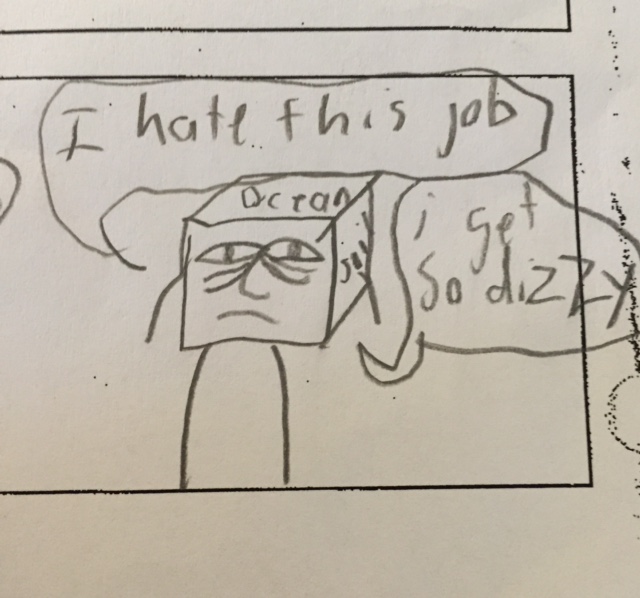
“Mrs. ATeam?” Gulp. It was A1’s new science teacher calling to say “First of all….let me tell you I think he is hilarious. He made this cartoon strip ….” He then went on to disclose all the other things drenched in awesomeness while I was waiting for the “Second of all….” part. That part never came. He called me to tell me I had a cool kid. And that was it.
I am already too experienced with the school system to be naive. That same morning I had to send an email to kindly remind another teacher to carefully review A1’s IEP and Health Plan as there were some important things not being followed. Coincidence to hear from the science teacher the same day? Probably not. I am guessing he may have just been reminded that he had a kid in his 4th period class who has an IEP and a Health Plan. Maybe not…but as I said, doe eyed ingenue does not work as well with crows feet.
Unfortunately, what struck me most about this amazing phone call is that in the 3 years that my younger A2 has been in public school…my very speech impaired child…I have never ONCE received a phone call from a regular ed teacher just to tell me about his day in their class. And let me be clear about 2 things. Real clear since this won’t apply to everyone.
1. A2 tries to tell me about his day. Every day. And we CANNOT understand him.
2. I have ASKED for communication. Over and over. Every year. In front of other people. To almost no avail.
So teachers…this advice is completely free of charge. The key to keeping us special ed parents at bay. 1. CONTACT US FIRST: Before school even starts, call to introduce yourself and ask about our kid. Give us your contact information. Assure us you are the extra eyes and ears for a kid who has no voice. 2. DON’T ASSUME THE INTERVENTION SPECIALIST IS JUST TELLING US EVERYTHING. My kid has a whole 30-60 minutes a day of direct IS time required in his IEP in our high-end-award-winning-district. My severely learning disabled child. The paraprofessionals who are with him most of the day are not permitted to communicate with me directly due to their classified employee status. We often get second hand info from our IS that sounds something like “had a great time in music class learning new songs”. The small tidbits we do get…well…that’s all…that’s ALL we get to know. The nuances are never there for us…if they are making a new friend, if someone hurt their feelings if they thoughts something was cool or interesting. And those things are definitely happening in my child’s world and no matter how hard he may try to share those things with me, if I have no context, I will not know at all what he is telling me let alone what questions to ask. The paras also are not allowed to attend IEP meetings even at my request. Were you aware of any of that? A2’s Intervention Specialist has 10 kids who can’t tell their parents anything about their day. She is ALL of their voices….and she is trying very hard to be all knowing by being the 3rd party communicator. But why? This is a team approach. While you do have 25 kids in your room, if they are lucky and have parents who actually ask them about their day, their kids can tell them. You have so much you can tell us and I guarantee all of us want to know. 3. INVITE US IN: To volunteer, to be a fly on the wall, to talk about our kids to your class. Did you know that neither you nor any of his other caregivers during the day are allowed to divulge any information regarding our child’s diagnoses to the other children due to HIPAA**? And there are SO many questions from children aren’t there? If you have an inclusive classroom, the information a parent can provide the children can be invaluable to the inclusive environment. Offer to include the IS to help that parent if they express interest but are uncomfortable. **IMPORTANT DISTINCTION: FERPA (Family Educational Rights and Privacy Act) any information that is directory information is ok to give out. So If a parent is asking for another child’s last name or to get in touch with another family, that is not confidential information if the family did not opt out of directory information. You just can’t tell us the child is on an IEP or anything regarding diagnosis. 4. RECOGNIZE WE UNDERSTAND YOU ARE BUSY: We are not out to get you or have a “gotcha” moment. I cannot imagine being a teacher right now. Huge classloads, jobs dependent upon test scores that are dependent on more than just your ability, differentiated instruction, outliers flying under the radar, helicopter parents, uninvolved parents. A 10 minute phone call once a month to tell us something we wouldn’t know without your call. If you do that once a month without fail you will likely never hear from us. But your principal will almost definitely hear from us. To hear how awesome you are. 5. INCLUSION AND INTEGRATION ARE DIFFERENT: This doesn’t mean let them also have a desk and have peers help them hang up their backpacks (though we recognize the value in that too). I mean if you take a picture of our kids to put on a bulletin board make sure it is a good one like everyone else. If you are in reading to the class and you ask a question the other kids can answer, figure out a way to ask a question that could include our kids’ ability to answer. While you have kids who can fall through the cracks, ours have absolutely no way to mountain climb out of those crevices without you. I am sure like us you don’t want them just to be a warm body at another desk. Ask their IS for strategies…that is why they are there.
BONUS #6 also at no charge: THE MOST DIFFICULT PARENTS ARE LIKELY YOUR BIGGEST ALLIES: Yep. We are the wave makers, the getter-doners. We figure out what you want and need and we try to get it for you especially if it will benefit our kids. Sometimes you don’t even need to tell us what that is. We figure it out. Assume nothing regarding our motivations.
For those of you who went into regular education vs. special education–those days are long gone. Inclusion is not just the responsibility of your Intervention Specialists. Much like us parents of kids with special needs…we started out in the exact same place as all the other parents in your room. Maybe even as you did too as a parent. Our journey veered off years ago but the desire to get to know the same thing we would have if everything turned out as expected has not.
Because L is ALWAYS for love when it’s about your child.
As a parent, as do many special needs parents, I find it confusing and sometimes a little unsettling when people say to me “I don’t know how you do it” or “I don’t think I could do what you do” or elevate my parent-ness to the likes of a saint. People are well meaning-I know the awkward sentiment is often a compliment of sorts, but it’s hard to respond. What is the most difficult thing you would do for your own child? Push him out of the way of a bullet and take it yourself? That would be mine, because caring for my child and meeting his needs is not even a close comparison to taking a bullet. We love our children with parts of our souls that we did not know existed before they were here. And I promise, guarantee, pinky swear you absolutely 100% WOULD know how we do what we do and you would do it too because there is no other option in the surrendered obligation of the deep love for your own child. So…if you have said this before to an autism parent, do not fret I don’t speak for everyone–we get what you mean. Moving forward consider this sentiment and instead try, “what is it like to be ______’s dad?” Or “how is physical therapy going?” Or “what is the most useful thing I can do to help?”.
In the month of our 15 year anniversary, I can confidently say we have embarked on a journey neither of us could have expected.
In some ways I wonder if our trek is easier than others since we never had musings of what our unborn children would be like or what kind of parents we would be.
…or if we would be parents at all….
I believe in a judicious balance between predestination and free will. Sort of like walking into a movie complex. You can pick the movie you will see, but once you choose it, the plot and ending remain the same. It is up to you if you decide to leave the theater to get popcorn or simply decide that movie is not for you and you should have never listened to Siskel and Ebert’s reviews to begin with.
All marriages require a gentle balance between cohesiveness and independence….and especially with families like ours. Stress is a constant, sleep deprivation a given, and child rearing? Well, throw out everything you ever thought you knew about that. Not everyone can do that. Usually, the stronger is left holding the bag on their own. I know too many families like that and watch in awe as the parent left behind carries the weight of her world.
Through thick and thin we give each other the space we need, recognizing we are in for the long haul. Our children are who they are supposed to be. We make the same mistakes as every other parent in every other union, but with the knowledge we must be united as forever parents, even long after we are gone. And for that, perhaps we are luckier than most.
An Occupational Therapist once corrected me in a meeting when I mentioned that A2 ‘s progress is like being in a race. She said “no, it’s like being in a marathon, you have to pace yourself”….but not having a child with a disability herself what she didn’t understand is that he needs to be front runner in that marathon if he has any hope of functional independence as an adult. As any kid ages, it gets harder to learn new things easily–neural pathways are set, myelination slows down…so early on every moment needs to become practice or a learning opportunity. We celebrate small steps toward independence with hope. After 2 years of task analysis, A2 can almost navigate a bathroom (with the exception of going) with minimal assistance. Yesterday, he independently ordered fries. But he cannot be alone or play outside without supervision, he cannot make his needs known clearly, he doesn’t know what to do in emergencies. A2 is not likely to ever live independently and as older parents without a caretaker for him this is terrifying. So we move forward and relish and celebrate every step forward with hope…and so does A2. Each step represents countless hours of work, practice and sometimes frustration. Everything he does takes 50x longer 100% more effort to learn than a child sitting next to him. His independence is truly the embodiment of a strong spirit and determination.
Lots of autism moms become expert level beauticians early on. I can scissor cut the hair of a moving target in 10 minutes or less without making my subject look like Moe from the 3 Stooges. But it’s been a long time coming…A2’s flip switched at about 24 months and haircuts became Wrestlemania meets the Exorcist with half-nelsons, projectile vomiting, sweating, injuries and lots of public interest. Many children with Autism fear hair cutting time as it becomes sensory overload for them. In addition to having to sit still for extended periods of time, the smells of unfamiliar products, the feel of a wet head the sounds of clippers buzzing becomes a sensory nightmare. Haircuts are pleasant experiences now in the comfort of our own bathroom and paired with Monsters Inc on the iPad and the promise of getting to use the vacuum for clean up.
This breakfast is 8 years in the making. A2 eats a total of 9 different foods..all presented in a certain way.–all brand specific. Starting from 0. He has worked so hard to get to this point and I feel a weird balance of pride, frustration and futility when I see this plate. Feeding issues in autism are common and are outside of “oh, all kids can be picky eaters” or “just tell him if he doesn’t eat dinner, he won’t get anything later–it’s not like he’ll let himself starve”. Because actually….he will. Many children with autism have serious food aversions and feeding issues. The reasons are varied but tend to be due to sensory, texture, medical or obsessive-compulsive issues. Behavioral issues become deeply ingrained in these kiddos when eating is paired with physical pain due to gut issues so common in kids with autistic disorders and can last a lifetime. So-the next time you are out to dinner and see a mom letting her kid eat Poptarts or a huge mound of fries for dinner–she may not be spoiling her kiddo….that dinner may also be 8 years in the making.
F is for Food…Part 2….Behind the kitchen door
There was this moment when my then preschool aged child and infant and I were sitting at the dinner table. I had my plate of one protein, one complex carb and leafy greens, napkin unfurled neatly in my lap, fork down after every bite. My prescribed Xanax appetizer was working as I sat there all June Cleaver-like smiling, asking about finger-paint and sandbox filled days, modeling healthy eating, modeling appropriate mealtime behavior…like I tried to every single day with little to no success. Dinner was cuisine and varied every night but there were 3 different dinner plates on the table. A1 wasn’t growing well and complained every mealtime that his stomach hurt. It would take him about 1/2 hour to eat even 50% of his meal but a big part of this was because he could not stay seated , would play with his shoes or get up to get a toy.
“Where are you going?”
“Did you have fun with your friends at school?”
“4 more bites.”
” You love buttery noodles, remember?”
“Don’t lick your shoes.”
“The timer hasn’t gone off yet.”
“I love this picture you made, tell me more about it.”
While this was going on, A2 sat strapped in to his high chair at the table with mounds of “power packed” foods. Macaroni and Cheese made with extra cheese, heavy cream and special calorie powder stirred in, crackers, whole milk with carnation instant breakfast. I was taking him to the doctor every several days for weigh ins because he was not growing or gaining weight with any normalcy. His Help Me Grow case worker taught me how to increase his calories…something that his dietician did not show me…or even suggest. He was eating about 1000 calories a day which was about the same amount I was eating to maintain pudgy and yet he still he would only gain ounces over the course of a few weeks. It made no sense. Most evenings he would sit in front of his food and not initiate eating so between my own bites I would a cajole him into letting me stick a Mickey Mouse spoon between his lips. He chewed funny. It did not look like he enjoyed eating, but generally he never fought it. But not this night. He turned his head from me and giggled at A1 who was now slowly sliding out of his chair, disappearing under the table. A2’s last weigh in he had dropped 4 ounces but we had no idea why. (Maybe I needed to put more of that Nestle Additions stuff in his milk? Should I switch to Boost? I think that has more calories. I wish he liked doughnuts!). In that moment, I experienced PXF (Parental Xanax Failure) and June Cleaver went bye bye. The underlying and increasing anxiety I was having at mealtime that caused me to medicate so I remained calm and cheery sprang to the surface and yelled “Ta da!!! Here I am everyone!!” I snapped at A1 to sit in his chair immediately and accused him of distracting his brother to the point of not eating….and his stomach is fine….so finish that spaghetti and garlic bread! I got out an assortment of spoons hoping A2 would pick one he liked better. He did not. As he sat thrashing his head from side to side and mooshing his lips together to avoid any possibility of the airplane making an emergency landing in his mouth I began bawling and begging him to eat like some bad drama actress from the 1940s. Meanwhile, A1 got up from the table to poop. What the hell was I doing wrong? Kids just eat, right?
About a year later, I dusted off that MOTHER OF THE YEAR trophy I earned that day and dropped it in the trash. A1 started losing weight and his pediatrician started taking his constant loose stools seriously. He had an elevated EMA (antibody test that is specific to gluten…as in that stuff found in spaghetti and garlic bread). After a week of no gluten he had his first normal looking poop of his life and soon after no more complaints at mealtime. A2 phased out all solid food before he turned 2 but was increasing the amount of Pediasure he drank. Within the month of being on a self-induced liquid only diet, he started sleeping much, much longer stretches, started walking and got consonant sounds. Sure, he projectile vomited 3 times a day but he seemed much happier. His head never spun around even once so we were fairly sure we were not going to have to call for an exorcism. To save money we switched to the a big box, El-Cheapo version of Pediasure. What we saved in monthly bills, we spent in clean up costs and therapy bills for A1 because the vomiting seemed to increase–as did his target range. And like fine wine connoisseurs, my husband and I decided the bouquet of El-Cheapo vomit was not as pleasant as Pediasure vomit. A1 and his hypersensitive sensory system were traumatized. (see exhibit A)
EXHIBIT A: Things he likes to smell: Perfume. Things he doesn’t like to smell: Vomit
Through deductive reasoning, I concluded that El-Cheapo brand was making it worse, we switched back and he improved. A few years later he improved even more when an integrative medicine doctor suggested he couldn’t digest dairy and thought he should be on a “pre-digested” prescription version of the same thing. “Oh…no. We had him tested, he’s not allergic to dairy…and our GI said its probably just a mito thing”. But sure enough within a few weeks of switching again, A2 stopped vomiting. Completely. And he was willing to play with and then even taste a few foods.
There is nothing more instinctual to a mother than nourishing her child. Our species would not survive if this were not the case. When your child has feeding issues it is normal to doubt your instincts, to question what you are doing wrong, how you are messing this up. Have I had to drop a few $20s into the therapy jar for later due to my own reactions? Sure. I am human and I find there has been almost nothing more unnerving than my child not eating or feeling sick when they eat but no one can tell me why. And when someone finally figures something out and they get better to start questioning EVERYTHING. Make sure you are being honest with yourself. Are you trying the best you can? Are you revisiting eating with your child? Are you trying to create a more relaxed environment at mealtimes? Can you, especially as a woman in this society put your own food issues aside? Pat yourself on the back if you can answer “yes” to those questions because your child will continue to thrive because of you. Breathe….and most importantly, enjoy your meal.
“Check water first”. The most terrifying emergency directive a parent can hear….and this is the protocol for children with Autism who go missing. Elopement, wandering, bolting, fleeing. 48% of children with autism elope. Drowning is the leading cause of death in kids under 14 with Autism. We are lucky-A2 only gets distracted and wanders to find things that are interesting without regard to safety or whether a familiar adult is nearby–but he does not run from us–which prevents so many families from being able to go in public safely with their child. One of the things that makes A2’s non-elopement complicated as that he is not a risk…. until he is. He can go a full year with staying in eye shot and then one day out of no where he will simply leave the house. With no warning. He also cannot tell anyone his first and last name with consistency or clarity. He does not know his address or phone number despite years of practice. He knows my full name, but unless you are a trained listener. you will not understand him. We all know to approach a young child who appears to be lost, but most would not think to approach an older child or young adult. Be aware–this is one way we can all be a village to our families!
Unfortunately, there are limited ways to actually prevent elopement behaviors. When we assume the function of behavior is escape we may be missing out on other factors. Does he bolt and laugh while doing it as he watches you chase him (attention)? Is he fascinated with streetlamps or water or heavy equipment and feels intense compulsion to go check it out (access or internal attenuation)? Does he seem to leave only in specific situations or with specific people? If you have a child that is a runner, consider tracking the behavior for antecedents and response or consequence (even when unintended), track the time of day and what was happening around him at the time. Track WHAT the elopement looks like…does he run or is it more like walking away? Does it change what it looks like based on the situation? Besides lockdown and direct supervision, understanding your child’s behavior through data collection is your best preventative defense.
As far as what else you can do if your child is an elopement risk…again, limited but both high and low technology options can be lifesavers. If your county or police department have a special needs registry, register your child. There is a national initiative and grant called Project Lifesaver that your police department can utilize and get wristbands with gps or radio signal your child can wear. Keep an up to date photo of him on you at all times. Create a card he can carry with him with his information and use discrete trial training to teach him to hand it to someone if he cannot find you. Consider a cell phone and GPS tracking or the Find My iPhone App. There are tracking devices like http://www.angelsense.com available for a monthly fee. These attach to the inside of clothing. Go online and search for other high and low tech options they are out there.
List of tracking, ID and safety products (not an exhaustive or all inclusive list): https://www.autismspeaks.org/family-services/resource-library/safety-products
It is easy not to move forward because we do not want to assume the worst…..but like for so many of us in many aspects of our lives with our kiddos…we have hope for the best…but plan for the worst.
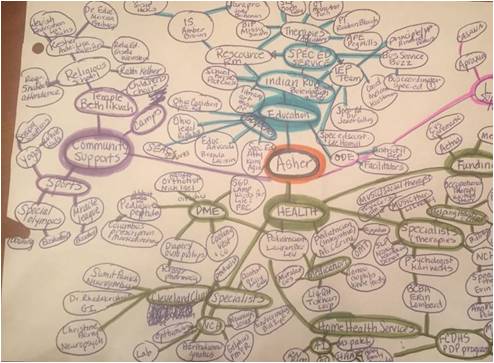
In grad school I learned this neat little thing called a ecomap…and then saw another mom post a personal one in a blog. A year ago, I decided to make one for the kids (for sake of privacy, a fourth of this map is not shown) For us, that means 37 total IEP objectives and 19 ISP service areas to track, 44 providers, 12 clinics and 6 agencies we are in regular contact. All before work and caregiving. When you meet a parent of a child with special needs–and if you run into them somewhere and they don’t seem to recognize you….or you already know one who seems extra high strung or flighty or snarky….well….cut them a little slack. Not everyone is built to keep this much in their head all the time.







 Running through Water
