Autism Awareness Month. V is for Village

IMG_8068

Because we are so immersed in this world of autism I have erroneously concluded that everyone who lives outside of this Village is already aware of autism. However, there is a secret sorority that exists…one equipped with a secret handshake and password. I am in that sorority yet have no recollection of agreeing to join. Autism is funny like that. The Village of Autism parents is a unique one. We are a motley crew of individuals whose path may have never crossed otherwise. We meet each other in waiting rooms and lobbies of doctors offices instead of in the PTO. We have closed blogs and Facebook pages instead of casual phone calls. We learn more about the newest treatments and resources from each other than we do from professionals. We talk about how well our child is pooping quicker than we will discuss how well they are doing in school. Though we are typically the least able to, we are often the first responders to others in the Village because we are more likely to reach out to one another than we would outside of the Village where no one speaks our language. And we find each other….everywhere and all the time. Today while sitting on the floor in the middle of the children’s shoe department feverishly tearing inserts out of shoes and hopelessly attemping to shove A2’s newest orthotics into them with no success I broke down and cried. Just sat there in the middle of the floor, surrounded by ridiculous shoes with flashing lights on the soles and sobbed like a toddler might who couldn’t find the shoes she liked. At that same time, I peered up to see a woman pushing a cart with one hand while calmly using her other to push her much-too-large child who was humming loudly down back into his seat. We made eye contact for a single moment and silently nodded–her nod seemingly said “Yes….I know those orthotics were made wrong twice before in 7 months and represents 6 visits to the clinic over that same time. Yes…..I realize this is the 3rd store you have been in today that absolutely does not carry shoes your 9 year old can wear with the braces he must wear on his feet. Yes….I realize that your tears are really about your kid and the pain and blisters he will probably have again that he can’t communicate or the weird, white 1960s Frankenbaby shoes the orthotics company will recommend that look nothing like what his school friends will be wearing. Yes….I see you….and I know you see me….” V is for my Village. The quiet, connected Village where my family lives.

Autism Awareness Month. W is for What It’s Like

Day 23

W is for What It’s Like

“There is grandeur in this view of life…..from so simple a beginning endless forms most beautiful and most wonderful have been and are being evolved”On the Origin of Species, Charles Darwin.

A few years ago I attended the funeral of a friend who suffered and died much too young. He was a scientist-a biologist, an activist, a researcher who was respected in his field and likely the smartest person I knew. He was also pedantic and opinionated with a biting but funny sense of humor. This combination engaged even the most simple of us but most of his friends were equally as interesting and I got to numbly stand in a room in Vermont in the dead of winter surrounded by them. “What’s it like?” a friend of his asked me…”having a child with Autism?” For a moment I just thought I was not in the mindset to answer that question but quickly realized I could NOT answer because in all the years I’d not only never been asked that but also never considered it either. It was the kindest thing anything had ever asked me about A2 and perhaps it was the somber tone of the day that rendered me without speech (which if you know me well does not happen often) or maybe I had always been so caught up in the action oriented nature of having a young child with autism that to contemplate that would stop me in my tracks and make me crumble….or perhaps in the moment I felt guilty for even thinking I would crumble and considered myself so lucky to still have those I loved around me regardless of circumstance while my best friend was grieving the loss of his partner……so I excused myself instead. What I have decided over the years is that it is a bit like A2 contemplating this fountain. It is weird and fascinating and wonderful and I have no idea how it really works or how it got there. I notice every single droplet from the ones that predictably slide down the posts to the ones that spit out to collectively leave me standing in a cold puddle over time that leave my toes numb without notice until its too late. There is no warning when the water will turn to an exciting spout of beauty creating a soft rain and visible rainbow or when it will create bursts of rainy arches that I cannot immediately escape leaving me far more drenched and colder than I want to be and on opposite sides of the fountain from whomever was standing near me. So Trevor…..that is what it is like……Thank you for asking

Autism Awareness Month. T is for Teachers and Therapists

Originally published 4/27/17

T is for Teachers and Therapists

112. A2 has had a total of 112 different teachers and therapists in his short 11 years. Some were hand- picked….some chosen by fate and luck of the draw. Some were published, lauded recognizable names….some were quiet presences of whom I cannot remember their names. Some have been with us for the majority of his life. Some have only jumped in for a blip of time in his almost 105,000 hours on this planet. Some were stellar, life alterers….some just showed up because they had to. Some interpreted my coolness or seeming indifference to them as being non-caring. Some recognized that I always had my child’s best interest in mind all the time and understood it was important for me not to be too attached for fear of losing perspective and not holding them accountable should his learning derail. All have had a permanent impact on my entire family’s lives and for all of them, I am grateful.

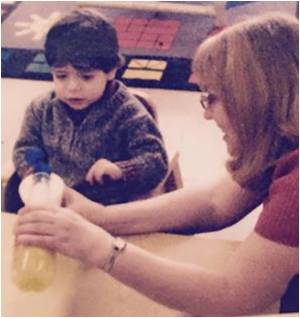
A2 was about 2 years old in this photo. Debbie Jo was one of the first handful of professionals to work with him, and at the time, I had no way of knowing this fact. She was a paraprofessional in his early intervention program and always made sure to seek me out when I would come to pick him up to give me feedback about his day. When this post was first published, she was very ill with a long bout of cancer. Despite her county job, insurance, COBRA and her life savings eventually ran out. Despite giving of herself and opening up her home to those less fortunate, at her most desperate moments, because a GoFund Me account was set up to help with medical expenses, I would have known nothing about the exceptional kindness and generosity she gave to others throughout her life other than that small blip on the map when my child showed up in hers. Debbie Jo died last year and I pray that it was with peace given the level of selfless life she chose to lead that I was never aware.

We fight for our kids. Many times that fight is with teachers, therapists and administrators. They chose their careers and they have a job to do. The are human beings. We know the people who are in this for the good fight and we know the people who should have left years ago. We know the people who don’t get it. We know the people who burn the candle at both ends and we know people who have dropped the ball. I have fought many of these people who teach my child, but typically as collateral damage in a system that is failing helpers and victims. Fight,fight, fight SO HARD for your kids. ADVOCATE like hell for yourself if you have a disability. Don’t be afraid to call helpers out, but BE FAIR. Ask to see data. It is your right to see it. It is your right to question it. Do your research. If you have an instinct there is a problem, be sure to tell them you are coming from that place rather than accusing them but again, ASK, ASK, ASK how to be reassured. In their world,  no matter how destroying it is to us, your child may be a learning experience.  And if that is all they can offer–it is all they can offer.

In our world…we only get one time around. We don’t get a do-over. Recognize their human-ness and recognize necessity and try to create the most cohesive balance.Featured Image -- 1500

Autism Awareness Month. O is for Obstinate.

Featured Image -- 1481

O is for Obstinate

All kids can be defiant. All kids can be persistent. Most can be both at one time or another…..however the persistence of a person with Autism can sometimes be far outside typical willfulness of even the most obstinate of kiddos. Most of this stems from intense need for familiarity, order and sameness of routine. This rigidity is part of the diagnostic criteria of Autism Spectrum Disorders. Sometimes I have no idea what will trigger A2 into a 3 hour long battle of wills. What can be a 5 minute routine one day can take 2 hours the next even when he knows that routine ends in something he enjoys. A1…no matter how much punishment, berating or time outs he got, he would get right back up and do the same thing over again. One summer I decided to ‘put my foot down’ and send him to the time out step after every single infraction.  No warnings.  That should teach him!  After about a week of this, there was a day that I had sent him 17 times all before my husband got home from work. And he went willingly. Every. Single. Time. Something was very wrong and thankfully I had a moment of clarity.  I got a clear cup, drew some lines across it and found a bag of marbles.  Every time I caught him doing the right thing, I would throw a marble in the cup with the caveat that he couldn’t point out to me how good he was being. Unless he hurt someone (which he never did), there was no more time out step. Every time we filled the cup to a line, he got to pick what we did next in our day.  If we got to the top (by the end of the day), he could get a dessert after dinner.

Just. Like. That. Everything was different. He would listen the first time and look out of the corner of his eye to see if I was digging for a marble. He got double marbles if he initiated social interactions. Before long, we were engaged in pretend play in the basement.

I had someone close ask “Don’t you think it might not be autism?  Don’t you think it is could be his personality?”.

“Well, ” I indulged “if everything we do serves a function, what function do you think his behavior served that week?”  Without much hesitation, she drew her hand up as if she was grabbing something and said “To have a ‘gotcha’ moment!” I thought for a moment.  “What 4 year-old would rather sit on a step over and over, day after day instead of playing just to get under his mother’s skin? Isn’t a week long enough to learn that without the behavior increasing?”  A four-year-old.  Clinically, that would be a much, much bigger issue than autism.

Before that, I used to joke about how even a dog can learn to salivate to the sound of a bell when paired with food over time, yet I could not get my child to understand how his behavior had anything to do with the consequence he would receive. It’s one of the most bewildering and frustrating parts of parenting because regular consequences do not work. Though A2 may connect consequence to behavior in the moment, the pathology outweighs all and it is likely that he may not learn from his behavior for the next time.  A2’s Childhood Apraxia of Speech required us to do drill work with cards for sounds and words over and over.  Did we create some of this rigidity with him because of this?  Probably.  Did I have any idea that would be possible then?  No. But the trade off was that he learned to try to speak and can make some needs known so that people other than me and my husband understand.  Was it worth it?  As a parent with limited understanding and resources  I would have to say “yes”, because he displayed rigidity before that.  Even as I add to this blog post from the original version written two years ago, I realize how much I have learned to even question if this was possible.  We have lots to continue to learn.

Autism Awareness Month. Day 4 2017: D is for Dreams. Poetry for My Son Without Words

FullSizeRender(38)

What do you dream about sweet silent boy? 

The nights you rise up out of your bed and wander our dusty floors?  Are you looking for something you cherished for a moment in that mysterious place between the consciousness of dream and the awareness of waking?

Are you on an enchanted night walk floating through a maze of fireflies and bubbles unaware of the world that holds you back?

Could you be lost navigating the spooky hallway forest, familiar and friendly when the path is lit by the morning sun?

What do you dream about sweet boy?

Those nights your shriek summons me like the siren’s song to find you swimming in your twisted sheets?  My soft words are not your anchor.  You push me away from the helm with your kicks and punches as if resisting being dragged to the bottom of the sea by the mighty whale you have have come to exact revenge.

How do I teach you to breathe when you emerge from the black water instead of screaming?

You wake gasping for air.

What do you dream about sweet boy?

When you sit bolt upright rubbing the glitter of sleep deeper into your eyes with the fists that once fit in the palm of my hand?  You rise with a dreamy smile that does not release either of us until you snuggle in as close as you can. It is how you summon the halcyon to create the calm winds that smooth the waves.

You drift safely on your back.

Do you know you dream sweet boy?

Can you separate day from night? Do your lost words in the light morph into the demons in the dark who suck the words from your cherub lips?

Do nocturnal fantastic birds of flight carry you away and release you from your forced secrets of the day?  Are those birds the thing with feathers?  Do they chirp the same songs they sing to me?

Do you not dream at all sweet boy?  

Perhaps instead you play with angels who speak your native tongue.  You drift off to the place where I am not allowed to go with you. You run freely through the fields of joyous detail or you ramble in teary despair in the wings of the worldless knowing you are understood and safe.

Because no matter the circumstance of night, in the morning  you wake wide eyed and blinking and peaceful.

FullSizeRender(37)

Day 4 2016: D is for Diagnosis

Autism Awareness Month. Day 2 2017: B is for Blogs

home-office-336378_1920

About 9 years ago when A2 was 3 years old, he attended a social skills group with a speech therapist and 3 other “non-verbal” children.  A2 was by far and away the most interested in communication and social interaction of the 4 kids in the group. At that point did not have an Autism diagnosis, nor despite my education or background did I even suspect this as the primary issue.

I sat in that lobby week after week wondering what A2 could possibly be getting out of the group given none of the children had any functional verbal language and a great majority of the time the therapists were wrangling to keep the kids all in one spot.  After the final session, I sighed at the speech therapist and asked her what she thought was going on with my beautiful boy.

She asked me if I had ever heard of the book Schuyler’s Monster by Robert Rummel-Hudson. A father’s memoir about his wordless child.

I had not.

A2 and I left the speech session and immediately went to the library to find it.  I suppose I would have been reading more about parent perspectives of young children with disabilities had a known my child had a disability.  But he was 3.  He had delays.  A gross motor delay, a fine motor delay, a speech delay. He had weird medical issues. He stopped growing.  He flapped.  But he also looked at me and smiled, knew his name and cuddled.  Other than the cache of bewildered parents who sat in lobbies at therapies, I had no connections to others going through similar circumstances. As an action oriented person, I didn’t know I needed to have those connections.

That is until I read Schuyler’s Monster. 

In some ways, I feel like that is where my story begins.  It started as an easy read because Rob is poignant, funny and his words wash over the pages and get right into your brain.  And then…..  To put it simply, I was knocked on my ass.

He was telling my story.  He was me. 

Schulyer was almost exactly A2 right down to the personality.  I had to set time aside to read when I knew I didn’t have to be “on” because I wasn’t sure how what I would read would affect me for the rest of the day.

Schuyler has a rare genetic disorder called Bilateral Perisylvian Polymicrogyria.  I called A2’s neurogeneticist at the Cleveland Clinic and insisted he himself go back and read A2’s baseline MRI and not rely on the radiologists report. He humored me and alas, A2 and Schuyler did not hold this in common.  I finished the book and felt like I was underwater.

What was I going to do without Rob, Julie and Schuyler?

I felt connected to something and yet I never felt so alone in my whole life all because a piece of cardboard filled with paper and a beautiful little girl on the front told me life might not be what I think it is.  I was not an avid reader of blogs and at that point was not on social media.  I found their blog Fighting Monsters with Rubber Swords and reconnected with his words.  Soon, I found another blog that spoke to me much in the same way written by a teacher who had an autistic child called Flappiness Is.

By this point, four years in, we had an autism diagnosis and I was in the throes of learning to advocate for my child in ways that rocked my world. Flappiness (Leigh) was there to say the things I couldn’t say. I then there was another (which is no longer around *2019 update…I have now seen her around..*) that made me laugh about our situation when I needed to laugh about it.

I now had a community and resources I could access whenever I needed it.

I am an accidental blogger.  I wrote 3 posts back in 2010 and when I realized I really had nothing to say, I was done.  It wasn’t my time to talk.  I don’t know if it is really my time to talk now, yet here I am.  Instead of following 3 blogs, I follow dozens and all for different reasons.  I have met the most amazing folks along the way because of it including the now very grown up, very kind and very inspiring Schuyler.  And she seems to be exactly the person I hoped she would grow up to be when I met her as a little girl as typeset words sitting on my couch 9 years ago.

There is no need to be alone if you cannot find “your people” in your community.  I never dreamed that some of my closest confidants are people I have never met or only briefly met in person. This list is not exhaustive…..and most categories will overlap, but my resource list of favorite blogs/social media folks you might want to check out (note also most blog links will be the same name on Facebook):

Day 2 2015. B is for Boredom

Day 2 2016: B is for Behavior

DAD PERSPECTIVE

Bacon and Juiceboxes

Jason Hague, Writer

Just a Lil Blog

Dad Enough

Autism From a Dad’s Eye View

The Spectral Zone

The Autism Daddy

PERSPECTIVES FROM THE SPECTRUM

Autistic Not Weird

Autcraft

Seriously Not Boring

Deciphering Morgan

Autistic Speaks

Kerry Magro

Anonymously Autistic

Autism Uncensored

MEMES/HUMOR/KEEPING IT REAL

Autism Odysseys

Just a Minute My Cape is in the Dryer

Ink 4 Autism

Rantings of an ADHD Mom

Memes By Ashley

ALL THE REST

David Snape and Friends

Carrie Cariello

Love That Max

Finding Cooper’s Voice

Take Another Step

Autism With a Side of Fries

Herding Cats

From Motherhood

Our Adventures with Riley

Special Ev

Walking With Drake

A Day in Our Shoes

Special Books by Special Kids

Autism Awareness Month. Day 1 2017: A is for Ableism

IMG_1277

Ableism: discrimination or prejudice against individuals with disabilities

(https://www.merriam-webster.com/dictionary/ableism)

“How old is……are you?”

The little girl in the pink rain boots corrected herself as her eyes darted from mine immediately to A2’s. He was staring out the window of the observation tower where we all stood and flapping in excited anticipation of a single engine plane landing right in front of us.

She licked the open space between her missing teeth and twisted her body from side to side. I looked back to A2 since he wasn’t answering her.

“A2…..this little girl wonders how old you are.” I said to him as I touched the corners of my mouth as a starting cue for a long /e/ sound.

“Sevuh.” he said without looking way from the window.  I touched his back and then his chin and he looked up.

“Eeeeelehhhvuh” he replied, eyeing me closely for the cue.  I looked back to the girl to see if she understood.  She bit her lip and looked up at her own mother.

“Yes, you ARE eleven!” I clarified and then paused to gauge interest.

“A2….you could ask her ‘how old are YOU?'”  I stated in a futile attempt to redirect his attention from the excitement of a helicopter taking off from a landing pad.

Hannah was 7. And her brother was 5. And her other brother had his birthday this weekend….and he is 3. And her uncle lives in North Carolina and he came in to town for the party and now he was flying away back home. And there were green cupcakes at the party. With rainbow sprinkles.

STOP.

When you read this, what do you take away from this interaction?  How did it make you feel?  Did you picture yourself as the parent?  As the little girl in the pink boots?  As A2?  Or maybe you pictured yourself as the mom of the girl?

Since I was there, I will share my perspective.

  • Had A2 been in almost any other physical environment, he may have been the one approaching the girl rather than the other way around. He may not have automatically told her “seven”, the oddly missing number from his rote lexicon from one to ten.
  • I saw an opportunity to practice social language and articulation. Another child asked him a direct and appropriate question in a shared environment.  In our society, it is the norm to make conversation in environments such as this. Even though he was distracted by something exciting, this is still the norm.
  • I saw another child who appeared to not understand what A2 said and also appeared to not know what to do next.  It then became my role to subtly articulate for the other child and to cue my child’s part in the conversation.
  • When I saw A2 was too distracted to engage in anything socially meaningful to this little girl, I engaged her for a bit to see if he would enter in at any point.
  • I was thrilled that this young child caught herself and re-evaluated how she wanted to ask her question and presumed A2’s competence by asking him directly.
  • I felt frustrated A2 missed a social opportunity.  I felt sad he would rather flap his hands.  I felt gutted to get more details about a 7-year-old-stranger’s weekend than I have ever gotten from my own child about his day.

I imagine the little girl’s perspective looked something like this:

  • I don’ t understand why he talks like that.
  •  I know when people want to know how old I am they ask me. They don’t ask my mom.
  •  I wonder if he wants to know my uncle is flying a plane?
  • He didn’t know how old he is.  I wonder why he won’t look at me after I asked him a question…I feel uncomfortable now.
  • I’m glad that lady asked me about my weekend.  I love cupcakes with sprinkles and was glad I could share my favorite part.

A2’s perspective might be:

  • Humming of airplane motors sounds like the humming in my body.  The propellers move so fast, but that is how I see so many things…its like I can see each blade when they spin.  This is the only place I get to see anything like this! I’m so excited!
  • Mom is tapping me.  She wants something.  When I respond to her, she will then leave me alone and I can finish watching.  I better look up.
  • That little girl has nothing to do with this experience right now.  Why does she need to know how old I am when there are machines flying into the sky?!

Of course, I have no way of actually knowing the perspective of the little girl or of A2. I can only assume according to my own interpretations in the moment and based on my previous experiences.  I may be completely wrong.  The only perspective in which I truly have full insight is my own as evident in the richer description.

WHAT IF…….

Is it possible that my intervention was sending a negative message because I didn’t fully accept where my child was in the moment?

Because I expressed honest thoughts and feelings over the scenario, does that mean I perceive my child who happens to be disabled as less?

Were my choices in this situation potentially fueled by own differences?  Would it matter if they were?

If I did nothing, would the girl have pressed on?

Would her mother tell her “come on, he can’t answer you” and leave before the little girl could wait him out?

Would she have learned that in the future not to bother to ask questions of kids who flap and have trouble speaking?

Should I have insisted he turn from the window?

Should I have answered everything for him?

Should I have explained what she could do to connect with him in the moment?

Should I have insisted the mother help her child connect with mine when he didn’t answer?

Do I represent all mothers of all autistic children?  Mothers of all children with Autism? All Autism Moms in this situation?

Does she represent all 7-year-old neurotypical children?

I am a parent.  I make many decisions for my minor children every day. I make them do things that go against what they want to do because that is an uncomfortable reality of parenting.  Sometimes I give in to things when I am feeling tired or lazy. Other times, I just make the wrong decision or don’t respect their feelings and apologize later. The fact that I am literally my child’s interpreter due to his disability complicates this parenting thing because I cannot untangle the ball of cords that being a parent to my child vs. being a parent to my autistic child is. I have no choice but to parent him from the only perspective I have day in and day out just like every other adult given the privilege of parenting. The thing I know for certain is every decision and action comes out of the intense and blinding love I have for them.

As a society, we are all learning together what it means to be inclusive, accommodating, and how language can affect disability rights.  The growing pains with this process are palpable.

Subcultures and their preferences exist in any community and are often elusive to the general population. But these issues tend to sit right below the surface for the group affected, creating a dissonance that effectively can halt any movement forward outside of the culture.

A simple/not so simple example:

Many adults on the spectrum prefer “autistic” as they do not see autism as a disability but rather as a difference.  Yet, in academia, person first language is still being regularly taught. Some parent perspectives dictate a different mindset around autism preferring “has autism” and would never refer to their own child as autistic. As a professional in the field, writer and parent, I trip over how to refer to autism, my kids or myself for fear of sounding ableist and this nuance could alienate the very community for which I want to advocate, regardless of my perspective in family systems theory.  When asking my own kids what they prefer, one says “yeah” to either option leaving me as his parent with the choice. The other has told me he doesn’t want to refer to it at all because he doesn’t care, doesn’t know why it matters or why he would ever have to explain it to anyone to begin with.  Clearly, this hot topic within our autism community, this invisible topic to the general population, is a complete non-issue to my boys.

It is all about perspective.

There are many voices making up the autism community.  There is a tentative balance in how we talk about autism and how we approach the disability perspective in the community. Perhaps it is because there are some great, big general rules of thumb when it comes to respecting individual differences and abilities. Perhaps it is because disability voices should get precedence as representative to their individual needs and possibly the needs of others.  Perhaps it is because sometimes those individual narratives are different from the realities of many families and it becomes difficult to separate this inconvenient truth when there are no other options.

My goal as a parent is to give my children as many opportunities to be successful and independent as they can be which means the choices I make for them as I google how to unwind that mess of cords will be based on their individual needs and the options and resources available. I also recognize that we do not live in a vacuum.  My experiences and access and circumstance dictates certain necessities.  I absolutely cannot expect that society as a whole will know or understand how to accept and provide the individual needs my child has based on his disability when I am not even certain I always know what they are.

There will always be Hannahs in pink rain boots who approach disability as a curious difference.  Whether she grows up with the same perspective is up to us as individuals, as caregivers and as a community in these brief moments. The one thing I know for certain is we are evolving toward a collective understanding from many different perspectives and these perspectives come from a place of respect and love. Almost always.  We all have to be better.

Day 1 2015: A is for Aides

Day 1 2016: A is for Advocacy
Clutching at the Heels of the Disabled: Why You Should Be Wrestling With the Idea of “Handouts” in Healthcare

white-1184178_1280I read a story this morning in the news about a woman in Texas who stopped on the side of the road to chat with a homeless man.  Since she passed him in the exact same spot  for three years her curiosity finally got the best of her . You can see it here.  He was thin, unshaven, filthy.  We’ve all passed “him” on the side of the road, haven’t we?  Remember the Man-With-The-Golden-Voice several years ago who hung out by the highway and  became a media sensation?  I passed him…sometimes twice a day on the way to my child’s school.  There he was–all wild haired and looking strung out. And then there he was on Dr. Phil with a Cliff Huxtable sweater and a haircut.  A former radio announcer who succumbed to addiction.  We were all cheering him on–he had a Golden Voice and would contribute to society with those gilded vocal chords.  And my, wasn’t he handsome with that haircut?  He could practically be someone we knew!

I digress. This woman from Texas stopped to ask this man why he was always in the same spot all day, every day.  He told her he was waiting for his mother because that is where she left him.

He was waiting for his mother. Right where she told him to wait for her. 

To be sure, his mother was not coming back and this man  struggled with mental illness.  But maybe she really did leave him right there the last time he saw her.  This could very easily be my beautiful boy.

Let me give you some background on this….

What you might not know is that he didn’t suffer from mental illness…that came later in life.  He also had Autism with a speech disorder and a learning disability.  He was raised in an affluent suburb with the best schools in the state but they failed to teach him to read.  This man’s parents were older when he was born, were highly educated, had good jobs and didn’t retire until they were forced to.  His grandparents were all elderly and required care themselves. His father had excellent medical benefits at work that covered most of his care and his mother was extremely resourceful and was able to access everything available from funding to therapies to alternative treatments.  This man’s parents saved as much as they could and because of his unique needs, his mother could not work full-time.  Care for a disabled child is a commodity.  In childhood, the man’s parents tried to give him the most enriching life possible with as much exposure socially as they could.  He found so much joy in being out in public going to sporting events, concerts, religious congregation events and festivals. His parents looked at spending money on these activities as investments since staying at home did not provide him with any social opportunities at all.  After he was about four years old, there were no more parties or play dates or neighborhood shenannegans. His parents were his best friends and gave him a life outside of the house.

This man was once an exceptionally adorable little boy and it was so easy for him to get attention and love almost anywhere he went.  That is, all the way up until adolescence.  It became confusing to him when people didn’t respond in the same way when he would wave at them and say “hey!” or approach their table in a restaurant just to say hello.  His parents put off making a trust because the idea of appointing a guardian was so daunting.  How do you ask someone to make sure your child is OK for the rest of THEIR lives?  How do you ask them to make sure that child has a guardian beyond THEIR lives as well?  Given his parents became increasingly socially isolated as he grew older, it was hard for them to even consider options.  So they just didn’t and hoped for the best.

The boy grew into a man and it was important to his parents that he felt like one. They insisted he held a job and helped him find work wherever they could.  As they grew older, their health issues became too much for them to be able to continue to change diapers or physically help move the man to safety when he got upset and ran in the direction of danger.  The man’s health care waiver ran out when he turned 22.  Reluctantly, his parents dipped into their accounts for his care and in less than 5 years, they ran through their life savings. The same amount of money that would have been considered sufficient in any other situation in old age.  The parents did everything right.  The man worked hard his whole life to be the most contributing member of society his parents could push him to be. And yet…..one day on the way to a doctor appointment, the mother asked the man to wait outside.  She was afraid that if the doctor saw she was trying to care for an adult with a disability he would be taken away…taken away to live in a substandard long term care facility…one that was short staffed where he would be living with strangers. The Medicaid cap would release him to the streets when it ran out. Well…frankly, it was better to let him wait outside, she must have thought.  That is until at that doctor appointment he determined she needed surgery immediately because all the nausea she was having recently turned out to be repeated heart attacks due to a blocked artery. Only she didn’t make it in time to let anyone know her beautiful boy was waiting on the curb for her.

And there he sat for 3 years.  Wandering for food. Wandering for help, but due to his speech disorder and illiteracy, there was no one who understood him enough to know who he was or what he was looking for.  He looked crazy. He looked drunk.  He sat and wandered until that nice lady finally stopped to ask him who he was.

This could be my son.  My beautiful boy.  The kiddo who is 11 years old right now. Of course, it is not.  I actually know nothing about this man from Texas or his background.  But I certainly can imagine this very real scenario.  It is a scenario that keeps me up at night with the exception of the kindly stranger and the happy ending on channel 10.  For those of you who believe people who live off the system have made their lot in life or that they are owed nothing…is this who you picture when you see the guy sitting on the side of the road?   Because that guy may have once been my beautiful boy….your white, upper middle class neighbor’s child who you thought was a ‘cool little dude’.  Where do you think those kids go when they have no one? (and if one more affluent person who knows my child says “well….THAT’S different” be prepared to introduce me to someone else you know milking the system.  Go ahead…I’ll wait right here.).  Because you personally know me and because you personally know him and we kind of look like you  does not make him more deserving than the dirty adult sitting on the curb you think you have never seen before.  That guy that is owed nothing. You just don’t recognize him because you keep your eyes on the road.

I don’t think…I KNOW that one day I will die. Unless I sell my soul to the devil, I am not sure how I will manage to work a  steady job through my own elderly death that will happen AFTER his . I keep reading how his care should all be on me.  And it most certainly is.  And my husband and I have done everything we are supposed to do.

Today.  Call your congress people TODAY.

Don’t know who they are?  Click here to get the name and contact of your National/State/Local representatives.  Don’t know what to say?  Pick out the parts of this article that spoke to you the most and read it to them.  Remind them that NO ONE is a throw away person….not any of their constituents.  Not even the ones that cannot vote.

Stop what is happening with the repeal of ACA.  $800 BILLION cuts in Medicaid are going to be made for tax cuts to people who don’t really need those tax cuts. Medicaid will come in block grants to states with caps….and those caps come quick.  Where will my baby go when he meets his cap?  1 out of every 6 children have a disability and many of them depend on their families to ensure the bulk of their care and with Medicaid to help where they cannot. I have split my time between working and paying taxes to the country I am asking to help and also providing his care.  What happens when my child is not in school and needs full time care?   How do you keep a job and ensure your commitment as a tax payer while also fulfilling your duty as a parent of a disabled child?  If I don’t have a job, he is a freeloader.  If I do have a job, I am a freeloader AND negligent. The circular logic for the reduction of assistance and subsidies is just that ridiculous.

I am glad to hear that man from Texas is doing well.  I am glad there are middle-class individual citizens out there who might stop their cars to find out how they can help.  This, however should not be my son’s disability policy. His life is worth more than a sound byte on the local news.

Autism and the Dentist: Top 5 Tips for Successful Visits

How in the world has it been 6 months since I have taken the kids to the dentist? After a rousing success this fall, I thought I’d share this again in hopes we can recreate using my own advice! Any tips or tricks for your kiddo at the dentist?

Jaycee Kemp's avatarRunning through Water

**DISCLAIMER**.  The first half of this is the How Did We Get Here part.  The second is How Can You Maybe Get Here part.  Feel free to scroll to the second part…I promise you won’t hurt my feelings.

“How’d it go?”  I hacked out with the phone resting between my ear and the bed.

“Well,” my husband hesitated, “After he bit through the little mirror thingy and puked all over the dentist she told me that you should bring him from now on since you have more control”.

I usually took A2 to all medical appointments but had succumbed to a virus that resembled the plague and the only thing worse than me having the plague is A2 having the plague.  Normally, Mr ATeam and I are a pretty good team when it comes to him but one area I quietly held resentment was having to be the heavy when…

View original post 1,301 more words

When Pain Drives Passion. What is Your Story?

fullsizerender35

As Kelly knelt  on the floor folding her lighting equipment into her duffel, she looked up at me and said in earnest, “I feel like we have to do this fast. These stories need to get out now.” I felt the sick sink in my stomach because I knew she was right, but we just got started.

I half jokingly refer to Kelly as “my photographer” only because “this girl who agreed to come along to take the photos of interviews I am doing  for this idea I had and had no idea what she was getting into” sounds lame..and lengthy.  Plus her quiet role moving about the room with the important strangers who agreed to bare their souls to me for two hours gave them legitimacy.  What do you call the person who helps provide authenticity to an experience?  I don’t get to own that part.

Kelly bore witness to a world she knew nothing about three months before she spoke those words to me in an Airbnb in Dallas, Texas. I met Kelly randomly through a friend the previous summer at a concert.  She was a confident, ticketless passenger on the way to a sold out show and found a scalper feet from the venue. I appreciated the cajones and thought she might be someone I would want to know.  I did not realize that five months later, on January 27, 2016 we would be sitting for our first interview of a few dozen across the country.

We officially started a whole year ago as of today. Happy anniversary Kel.

Words like inclusion, rights, entitlements, supports are finally part of every day vernacular but even by definition imply separatist “us from them”mentality and leave out the miles of mountain range between the first mile and the last. But to me, those words felt like more than just a start.

When I got up off the pavement a year ago, I  believed society and disability subculture were starting to speak some of the same language. I also believed that some of the narratives were getting further and further apart causing a rift within the movement. The time felt ripe to help normalize the experience of being disabled in a way that was not out of pity but rather in a way that lit up the path to be traveled.  It was time to assume that folks were coming from a place of not knowing and not from a place of not caring.  My personal mental exhaustion was not about my child or his disability, but the wholly unnecessary loneliness, barriers and misunderstanding by the world around us.  How off the hook is it I believed changing the world around us would be simpler and more empowering than kicking those pebbles out of the path one at a time?

At the time, not so hookless. I gave a TEDx Talk about the first step in climbing the mountain of disability advocacy as a society.  The itty-bitty baby steps of encouraging the general public to lay down misconceptions and engage in discourse with someone who is disabled.  I encouraged people to unabashedly just ask about things they don’t know. I called upon the disabled and their caregivers to collectively lift the stigma of living with disability by being honest and non-defensive in talking about what it’s like and what they need.  I traveled the country and spent hours and hours recording and photographing and connecting to regular people in extraordinary circumstances to put into pages and immortalize moments on glossy paper for them. I shined up a little piece of the internet for myself under a pen name to create and share in the most balanced way I could. People were believing in what I was saying.  People were hopeful. I changed minds. Momentum. Or so I thought.

Through this process, I held the value of neutrality and being non-partisan.  Everybody’s story resides in the same place within them regardless of the story’s beginning, middle or end.  Allowing people to tell their story while providing them with unconditional positive regard served as a catharsis for both myself and my interviewees.  I found it was not difficult to empathize with people whose world I didn’t fully understand or framework I did not fully agree.  In social media,  I shared stories of injustice or cruelty without solution or politics.  Awareness is the first step of acceptance…it is not the end result.

Alas, I am not an advocate.  I am a storyteller.

One year later, I am sitting at the same desk but in a very different place.  I feel scared. Was I was horribly wrong about this genesis of readiness for change?  It has been a challenge to remain non-partisan especially in a time when it seems that perhaps these stories sink to the bottom of the advocacy pile.

The other night as I sat hunched over my computer trying to put a cap on my 1 year experience, I tearfully told my husband we are beyond storytelling at this point. I am fearful of having too much opinion out of concern of not holding my neutral credo for the greater good. It goes against my nature as a social  worker. There is a war going on between human rights, human entitlement and government in a narrative that is getting louder and undeniably self-serving to each individual yelling. This goal of reasonable human rights only has a matter of time before we are splintered into pieces again and we are fighting against each other get what we need. It is hard to see where or how this will end right now. Issues that are truly a big deal today may seem like the good-ole-days in the near future. I worried about the juxtaposition of storytelling in an ocean of endless islands of stories. I was feeling disheartened and selfish that evening that this project was down the tubes.

Instead of walking away like he might during a moment like this, my husband turned and said “What if this is about change for the better after all?” He went on to contemplate the lack of passion and purpose as a whole in this country in our lifetime. The things that divide us and crawl under our skin has created less listening and more waiting for our turn to talk. Or worse yet, NOT waiting for our turn to talk and yelling over the opposition instead. He optimistically reframed this unprecedented business-as-politics as the catalyst of the birth of this generation’s common cause. The most powerful man in the world and those who surround him believe that there are “alternative facts” leading the rest of us into a state of despair and confusion over the possibility of never understanding what is true or real. This is the stuff of propoganda and crazy-making.

“But…hasn’t that been your truth for years?” my husband asked.

He was right. Those of us who live with oppression in some way or another in this country have been working off the premise of alternative facts for a long time. At least those of us who are caregivers to those with disabilities who may not be able to speak for themselves, we are told over and over to accept half-truths or are simply told “no” for nebulous reasons when asking for inclusion, equality or safety.  Or else we are dismissed,discounted or ignored. This is not new. Some of us sink into deep holes of acceptance of this and others of us jump up and down and yell as loud as we can. And sometimes we do both in intervals. It is through this collective place we can pull together instead of being one small group spitting into the wind while down wind from us is some other oppressed group covering both of us in spittle.

“I wonder if there will grow a common one big enough to make the noise it needs to? People as a whole are a lot more awake than they were…and maybe that is not so bad” he mused.

Regardless of what you believe or how oppressed or even how entitled you are, it is time.  Listen calmly. Don’t wait for your turn to talk. Take the information you get from other people’s stories and learn from them even if you disagree. Even if you don’t understand. These words may help heal or give you the tools to fight even harder or maybe even change your mind. We can yell as much as we want in the faces of those who don’t want to hear….collectively it may eventually work…but individually, that will not change their minds in a world where people are desperately trying to cling to what they think they believe.

It is time. We all have a story.  Kelly can tell you what it is like to bear witness to that listening from behind a camera first hand.

Or as she might tell you, it will make you woke AF.