Why I May Have to Abandon the Best Coping Skill I Have Ever Had

facebook-1563273_1920

My heart is sitting in a basket on my desk next to my computer.  I stare at it wondering if I should leave it where it is or if I should shove it back in my throat where apparently it now belongs.  I  am faced with a dilemma I have fleetingly looked in the eye before but this time I pause much longer as if memorizing the outline of the face of a loved one I may not see again.

I love Facebook. I am like a Pavlovian dog when I hear that DING! and will switch over from work to see whats going on my feed.  Facebook is the most existentially layered version of the real world I can imagine. Everyone from my closest friends to those folks who have crossed paths with me for a brief yet meaningful time are there.  It’s the place where my elementary school besties and bullies post about their versions of how they turned out. People from a former life who hold keys to doors which ushered me to my current self are there too. There are writers and authors and even a real-life famous person here and there (sorry…I won’t out anyone) in the cache of my 560 nearest and dearest.  And I have access to all of them at the same time all of the time.

I take real 1-2 minute life diversions on Facebook multiple times a day.  It’s a weird and somewhat pathetic paradise.  Being a working mother is complicated enough, but I have a few extras thrown on top including a husband that travels and kids with varying special needs which means extra meetings for school, schlepping to therapies, staying current on research, hiring, supervising and managing a home team…and that’s all before actually dealing with the territory of settling in at the end of the day with  kids who just need extra.  Just when I might be taking myself a little too seriously or am feeling a little too isolated…boom….a cat video or Joe Biden meme reels me back.  Connecting in cyberspace is so much more my style and because of that connection I know I am not alone in this.  When I deal with work situations that matter to me, I am a rock star.  I have a purpose and can completely focus externally on the needs at hand.  But socially…yikes. Eye contact, staying focused, not accidentally making a connection out loud as to how the topic focuses back on something I can relate to better….none of those things are my forte.  When posting on Facebook–I can be funny and smart in sound bytes. I can get hoards of people invested in an ongoing saga about my fear of spiders.  I can walk away from a conversation mid-sentence without consequence.  I don’t have to think about where to look or how I am coming across because unlike in real life, by the time my human brain catches up to my monkey brain I have not yet hit “enter” and can edit what I REALLY wanted to say.  Sometimes those two things don’t catch up and that is what the “delete” button is all about.

Facebook levels the social playing field for quirky people like myself.  It gives me a social outlet when I don’t actually have time for a real one.  It keeps me invested in people, events and causes that are important to the real world all around. It provides an escape into brief, clever and timely humor.  It helps me find like-minded people.  It expands the repertoire of  discussions and ideas of which I might not otherwise be exposed.  And I can have all that in tiny spurts all day as needed. It really is miraculous if you think about it.  Communities of individuals who never stood a societal chance before are finding their communities right here on Facebook.

We know to take the good and the bad here. On good days, Facebook is my outlet. Internet trolls and maddeningly misinformed opinion presented as fact are the yin to the yang of my Facebook fascination.  I can roll past things or people who ultimately shouldn’t matter to me.  Something that I fail to do all that well in real life.  But this is changing too quickly for me to cope with in a way I find  acceptable by an election that divided the country before I had any idea we were THAT divided.  I am overwhelmed by Facebook friends and their words of hate or indifference being presented on a platter and served up as just another white meat with no other options for dinner.  I am breathless because I don’t feel like I can scroll past any article that has anything to do with leadership appointment, policy or ideology that may affect my family or anyone else I love.  Suddenly, realities of Facebook friends as minorities, the poor or disenfranchised are inundating my news feed faster than I can read, process and consider and as a seasoned social worker I feel like I am back to my overwhelming roots of weeding which causes need to get the majority of my energies and time.  I have a list of issues and phone calls to congressmen that will trump my everyday life tomorrow.   I am sad and fearful and agitated and distracted and rightfully so. While I have felt this way before on social media, I shut my computer down for the evening, be completely present and come back to a virtual life renewed. I can go back to meaningless status posts that make at least me chuckle at myself. However, in this political climate, I would be this way without Facebook and am having trouble finding meaning in those meaningless status updates. And with it?  Well, I feel much like I often do about real life.  Like I need to take a break from it.

Now I lay me down to sleep….

cherub-retouched-2

4:17am

My beautiful boy wandered into my room tonight.  His curly hair tousled around his cherub cheeks, pajama bottoms twisted in a spiral around his hips from tossing and turning…he marches in quickly as if he had somewhere important to be and then suddenly stops at the foot of my bed with purpose.  He rubs his dazed eyes all the while smiling that big Cheshire Cat grin of his. “Hug”, he says as he makes that long trip to the other side of my California king.   I can’t say I hate it when that happens.  He is warm and cuddly and doesn’t thrash and kick like he used to when he was little.  To the best of my knowledge, A2 has never slept a full night in his life and no one can tell me why.   As he gets older, he seems no worse for the wear for it either.  The stretches between night time explorations have become longer and my husband and I have become a tag team settling into separate sleeping arrangements at night over the years to ensure at least one of us wakes to the new day refreshed.   He tells me “scootch magooch” as he encroaches on the sliver of bed where I sleep and drifts off as swiftly as he made his declaration of his sleep intentions.

The thing is, my husband and I never wake up fully refreshed.  There are Things That Keep Me Up at Night. Who will hug him when we are gone?  Who else will find his sweet smile so endearing even at 3:00am?  We try to be optimistic about his future.  A2 will likely never be able to live independently, but dammit, we bought him a house and we rent it out to people today so in 15 years he will have a place to live….maybe even with 24 hour support staff and 2 or 3 other guys who are sweet spirited sports and music fans like he is.  We live in an expensive school district despite struggling to afford it to make sure he has the best education and connections for his future.   Though we are socially isolated as a family because such is the nature of autism, I remain involved with my religious congregation so he is never alone. SOMEONE will always know and recognize him.  I advocate and I write and I stay present in the disability community so he will always have that community too when it comes time for some else to step in as a guardian when I can no longer do it. A touchpoint for that kind stranger to get guidance or direction. We save the best we can.   We plan for the best possible services and outcomes to give him a meaningful life worth living. We are uncertain what services  will help house him, feed him, care for him.  We can’t be sure that there will be vocational training or health insurance or social security disability payments. All of which is unnerving when you know there will be no one to love him or snuggle with him or wipe away tears.  So we plan as best we can knowing surely, there will be some kind of services for him.

But tonight there is no sleep because now I am not so sure.  I know in the morning light I will look at everyone with a suspicious eye and wonder who around me willingly voted for another reason to keep me up at night. Half the population wanted political change and they got it and whether the overt intentions were there or not, they were willing to make children like my child the sacrificial lamb.  My child will always be dependent on others to be his voice, to protect him….his rights, his body, his dignity . My child and others like him often have no option but to live in poverty and have no political influence as adults.  I am terrified for him because no matter how much we plan, no matter how much we go without today, if it is acceptable for the leader of our country to marginalize him, make fun of him, call him the R word what does that say for the people around us who brush that off and traded my baby in for not voting for the vague “yeah, but she’s worse”?   What happens when it is a decided that my “standard retard” is a drain on the system making everyone elses’ life more difficult?  There will be a supreme court in place likely for the rest of his life who will err on the side of believing that as a universal truth.

The only politics I ever talk about in my writing is my belief that most people are good but misinformed. Perhaps not in my lifetime, but certainly in his, I believed that it was possible to change the world around him enough that true inclusion and a dignified life were possible and through that, the need for the work of disability advocacy would dwindle.  Perhaps I truly believed all that because I see the innocence in his eyes.  He is a pure soul who has helped me see good first and maybe I can spread that message for him.

So, forgive me if you were one of the people who so desperately wanted political change if I seem a little distant from you.  While I am hopeful that my fears are akin to “they’re taking all our guns from us!” it’s a bit harder for me not to be devisive when we are talking about my baby.  But don’t worry….A2 won’t judge you.  He is forgiving and will love you anyway.

Gratitude with an Attitude. The Bigger Picture of Advocacy.

fullsizerender33

It is time again for the November Thankful Challenge on social media. For 30 days people publicly declare the things in their lives for which they are grateful. As a therapist, I can tell you it’s an excellent daily exercise in mindfulness–a way to connect and be present for those things we tend to take for granted. Soul soothing salve in the bustle of every day life.

If we take a few minutes every day to reflect on the things that are going right amid the trashcan fires of life all around us, over time we can actually retrain our brains to become more centered, less reactionary and supposedly just happier in general. It becomes a good habit.

So, why don’t most people take appreciative stock every day? 

I believe its because most of us have what we need (most and need being our operative terms). So even if you don’t have much, you DO probably have a roof over your head, access to clean water, some kind of education and likely one person in your life who cares when your birthday is.  Those are things we easily take for granted. 

This doesn’t always feel so much like gratitude in comparison in our rich-kids-of-Instagram kind of society. Things like rampant poverty in the streets or dysentery are not infused in our every day life. Yet as special needs parents or as disabled people, it feels like we are expected to display this type of gratitude of circumstances in moments when it feels just this imbalanced.

I have somehow won the life lottery and I didn’t do anything to deserve that any more than some starving, orphaned toddler in a war torn country did to deserve his lot. There are many people who might look at my family and think otherwise since we were dealt the hand of having a child with a disability. We have a life that can be exhausting and lonely and sometimes just very scary, but rarely because of anything my child has done or his disability itself. It is more about the circumstances around him prohibiting understanding, access, equality or equity.

Thus the rub of the special needs parent and the expression of gratitude toward professionals who serve their child.

If someone asked my child’s providers,’Do you think A2’s mom is grateful for the services you provide her child?’, my guess is that at least 80% of them would answer ‘no’. They would be completely wrong, but still.  If that same surveyor could time travel and go back year by year to 2007 when A2 first started getting help and ask the same question, I  suppose the percentage who would answer ‘no’ would shrink in proportion to year asked.

For many years, regardless of how many holiday gifts, number of hours I volunteered, amount of money I donated, number of thank-you’s doled out, at this point I am still going to be seen as a wistful pariah to those whom I ask more. So out of self preseveration, I have stopped creating debt and sparkling thank-yous unless I really mean it. And that breaks my heart for everyone.

As A2 ages and the disparity in needs between he and his peers grow, so does the need for advocacy. 

There is a pervasive belief system which keeps those who are disadvantaged in some way from asking for more and it is through the guise of gratitude and the false belief that the basics are a form of entitlement.  You are lucky to get what you get, even if it is not meeting your needs.

  • 20 sessions of speech therapy for your non-verbal child?  Well…at least your insurance gives you that much. Some people can’t get speech therapy approved at all!
  • I’m not really seeing progress in my child, but the aides are nice to him and he seems happy.
  • He doesn’t need a bus aide.  He can make noise so its not like it would turn out  like  that boy who died on his bus because they forgot about him all day….
  • Sorting nuts and bolts is a career for lots of people. She may have an above average IQ but she’s lucky anyone is willing to take a chance on her
  • Kids just love him here at school, but no….we can’t tell you who any of them are so he can invite them over and extend those friendships to the community.  At least kids play with him here, that says a lot about the kind of person he is.

When exposed repeatedly to systemic issues that shame you into to accepting less, you get a little crisp when it comes to the process of fawning over people doing the jobs they chose. Can you imagine for one minute being OK with your child failing a subject at school and then thinking, ‘well…at least no one is hurting him there’?  No…those things are not interchangeable. Ever. As parents, we want to always feel and show gratitude to those whom we entrust our children, but when trust is bent, even a little, it dulls the surface.

A couple years ago, during a conversation, one of A2’s team members let me know just how stinkin’ cute A2 was and how he brightens everyone’s day and how much kids just love him.

“He has made so much progress..he always asks to see the PA system!”

I nodded and smiled and said nothing about how platitudes like that can ruffle the feathers of pre-adolescent special needs parents because, you know….gratitude and grace. We have to show ours a bit differently.

It’s not that we don’t like the compliment. It is kind to find the strength. However, very soon, that go-to strength of being little and cute, the thing that draws people to him and keeps people friendly will be gone. Drinking out of a sippy cup with a full beard might be confusing and odd to those who don’t know him.  And it scares the hell out of me. So instead, I say nothing for fear of not seeming grateful for at least his current level of adorable.

“Yes, progress.” I say. “Though I worry. He still cannot read, we still have not cracked that code and he only has one more year here.”

She side eyed me, flashed a knowing smile, lifted her finger as if to gently stop me and said “Mrs. ATeam, you GOTTA focus on the positives. You just gotta.”

Do I though?  

Focusing on the positives is actually WHY I have to advocate and ask for more. It is not for the purpose of making sure other people can see my gratitude. More out of the box thinking, more time, more energy, more inclusion. I see what he is capable of achieving all while being systemically reminded in IEP meetings of things he still cannot do, how services won’t be expanded to accommodate that fact and how planning for a future where if we are lucky, he will get to be a marginal member of society. Unfortunately when faced with this frustrating reality, as a mother I don’t have enough energy left over to make people feel good.  I used that energy up in the front end not realizing what lie ahead.

My child lives in a society that sees the deficits, that sees the differences and believes that the slightest hint of meeting his needs because of his differences is an entitlement.  A society that believes that being adorable is a strength. A society that makes heroes and saints and examples out of others showing my child dignity when they come to work or are being a friend. A society that doesn’t hashtag abuse, neglect, bullying and even murders against children like mine.

So team members…if you are confused about my level of gratitude for your involvement with my child, don’t be.  I am never short on gratitude and when my child is happy and progressing, what our collective efforts are doing is working. There is nothing for which I could be more grateful, just like any parent.

But I understand.

I too have a job where the pay is low, the paperwork is tedious and 100% of my work is about helping other people. I too am rarely told thank you. But that is not why I do what I do.  I am trying to make the waves to change systems and influence the way the world sees people who are at a disadvantage.

By accepting less simply because we are told we should be grateful for what we get is the dysfunctional thinking that will keep things inequitable.. always.

I am doing the future of disability advocacy and everyone who works with kids like mine a disservice by this act as well. When I am sitting on this side of the table,  its my job to check and double check your work, ask questions and tell you when something isn’t working.  That is not the opposite of gratitude, that is showing you that what you are doing matters. Its the ultimate compliment.  My kid is your boss and I am trying to teach him to always get what he needs based on HIS different needs in this world.

I’m just trying to do my job as his mother, one that is universally never the recipient of gratitude is often met as if I am a villain and yet is still the most rewarding job in the world.

5 Pros and Cons of IDEA: What Every Parent (and educator!) Should Know

IMG_4868
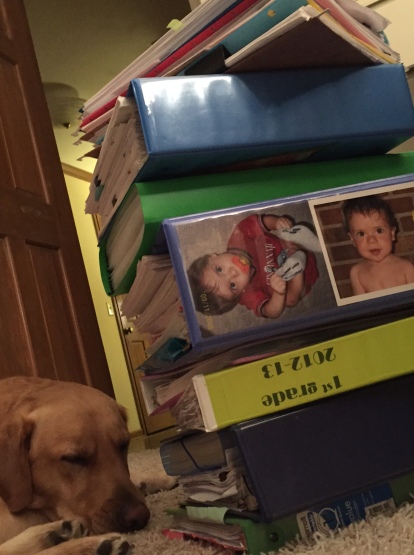
This tower is 4 years total of educational paper work for 2 kids and represents approximately over 300 hours of meetings, evaluations, reading and combing over data….JUST AS THE PARENT

I is for IEP, IDEA and Inclusion.

These three “I” words have forever changed me as a person.  If you have a child in special education, you probably just had a shiver run down your spine just by reading those acronyms in print and may be thinking the same thing.  All of these things serve as a blessing and a curse to our kids…and also to the educators and administration serving them.  Back in the day, the Individuals with Disability Act (IDEA) was enacted to refine and replace what few laws there were to protect children with disabilities within the education system.  It was meant to also focus more on the individual rather than on the disability itself.  IDEA has been re-written several times since 1990.  There are several things it does both in a good way and also in not such a good way:

  1.   It provides a free and appropriate public education (FAPE) to all kids regardless of disability at public expense.  The key word here being APPROPRIATE. The downside: There is a pretty decent chance that what you and your child’s test scores say and what you know is appropriate will be very different than what the district thinks is appropriate.  And most likely because of that other key word….FREE.
  2. Evaluations:  This law makes sure that children with disabilities are evaluated in a way that makes sense.  We don’t want to use one specific test to decide if a child needs special education services.  That way  discrimination is prevented and ideally, these evaluations serve as a tool to know exactly what they will need educationally. The downside:  Evaluations are only as good as the people trained to administer them….and only as good as the educator who can recognize an issue in the first place.
  3. Individualized Education Program (IEP): These are legal documents that establish goals, accommodations and modifications to the general curriculum and access to qualified professionals to ensure that a child with a disability is learning at the right pace and to his ability within their environment.  These plans level the educational playing field for those with a disability.  The heart of special education.  There are 13 categories under which a child may qualify: specific learning disability, speech and language impairment, blindness, deafness, hearing impairment, visual impairment, orthopedic impairment, traumatic brain injury, autism, multiple disability, other health impairments, emotional disturbance, intellectual disability,  The downside: Because they are legal documents and may be audited and are monitored on a quarterly basis, educators may have a very high self-preservation incentive to make certain your child is meeting his goals….at least on paper.  The more savvy the parent, the more tricky this can become.
  4. Least Restrictive Environment (LRE):  This ensures that your child is placed in an environment that meets his needs as independently as possible in an educational setting that is appropriate for him.  The goal is to work toward the LRE.   The downside:  For those of us with kiddos with Autism, this is not always cut and dry.  Especially those who are cognitively intact but perhaps have a language impairment or another issue which may stand in the way of independence.  An emerging issue in the field is for those kids who are considered “twice exceptional” such those who are intellectually gifted but with severe behavioral issues.  And what does “least restrictive” mean anyway?  My kid who needs 1:1 to learn can totally sit in a regular classroom to do that.  However, I believe my district interprets LRE to mean that he be in a contained classroom without a 1:1 because then he might have more physical independence in that room.  Who is right?
  5. Protections for your child…..protections for you as a parent:  Because of IDEA, there are procedural safeguards in place to make certain that your child is receiving the services the school says they will provide and a protocol to follow if you believe they are not.  Additionally, these protections allow for parent participation and child participation as an equal member of the child’s school team. The downside: Let’s face it…if you are not an educator…or even know where to go to get what you need, you will never be an equal member of your child’s team.   Procedural safeguards and parent participation are ultimately only as good as the questions you know to ask, as your attorney and your bank account.  The catch-22 if you do live in a very good school district?  There is a good chance that anything that goes to due process is going to take a LOOOONNNNNGGG time.  And think about that for a second.  If there is a FAPE violation and it works its way all the way up to a due process hearing doesn’t that seem counterintuitive for your school district to allow little old you to go to court with them?  Wouldn’t it make more sense to fix the problem as it would be much cheaper and less time consuming to do so?  It’s not.  At least not to them.  Because no matter how much the school doesn’t want to throw money at something they can still probably afford to pay a better attorney for much longer than you can.  And besides…the year and a half it could take…perhaps that child won’t need what it was you were asking for by then…or make your life complicated enough that you will break and succumb.   That seems like a pretty good gamble for a district.  And then it doesn’t set a standard for other families to ask for the same.

The last 25 years have been interesting ones for the education system as a whole.  When the parents who walked before us clawed and fought and struggled for these laws it was at a time before the internet, before all the revisions, before standardized testing existed in the way it did, before No Child Left Behind and before Autism was 1:68.  IDEA is necessary no matter how you slice it, however it exists in a very different system than it did in 1990.  At this point I know a lot of the law like the back of my hand and the parts I don’t know I am now educated on how to find those rules.  I have a list of socio-emotional goals for almost every developmental issue at my finger tips and I have an entire community of people going through the same struggles I am at the click of a button day and night.  All of this has been achieved through this tiny-huge world we have online.  I know exactly the gap closure between special education kids and regular ed kids not only for my district, but for my school.  I know the 6 payment tiers that exist and the formula used to calculate how much extra funding my district for each of my kids for using special education services.  I know what belongs where on all 13 sections of the IEP and how to make a goal measurable. And I know when I am being BS-ed by my district.  I don’t know all of this because of my training…I know it because I live in 2016 and any parent with a computer and the desire can learn the same.   In 1990, my school district certainly was not expecting 1 out of every 6 children attending (or 15%) to have some sort of developmental disability….or for the Autism rates to be 600% higher.   My child’s elementary school currently has about 700 students and about 100 IEPs (last I heard)…all while serving about 29% of their students as English as a Second Language with limited proficiency.  Teachers are stretched thin. Inclusion and LRE are so important for our kids future, yet most regular education teachers were not taught the basics on how to include and teach special ed kids in differentiated instruction or how to manage a classroom where there are multiple children with conflicting accommodations. (ie:  When Johnny gets stressed, he can crumple paper…but Jimmy’s auditory sensory integration issues make it impossible to keep it together when he hears paper crumpling….).  Parents are communicating, educated and knowing the legal hoops to jump through if their children’s rights are being violated.  It is a system that cannot hold itself up and still serve our most vulnerable children to be the most successful they can be.  Parents…please keep fighting for your kids….keep learning everything you can.  Educators…please do the same.  I do not have the answer….I am just hopeful it is found before my children have to move on from the “protective bubble” of IDEA and there are no grown up IEPs.

Day 1 2016: A is for Advocacy

FullSizeRender(9)

A is for Advocacy .

Today is World Autism Awareness Day.  Coincidentally, it is also the day that I will be speaking in front of a very large audience at a Tedx Event stealthily addressing the first step necessary in tackling the mountain for disability advocacy as whole in society. About a year ago I realized that I was advocating my way to an early grave.  The individual battles, bureaucracy and other professional’s personal agendas were getting to be insurmountable.  So I stopped.  I don’t think I have looked at a piece of paper with either child’s name on it in almost a year.  I did it out of self-preservation….I did it as a life insurance policy because I have to live one day longer than A2.  My real life insurance policy runs out in 7 years so I either needed to up the ante and increase my red meat consumption to run out my clock or back away.  I chose back away.  And during that time a metamorphosis occurred.   I realized that it may be much easier and much more impactful to change the world around my children through advocacy rather than to fight the good fight one arduous and marginally successful battle at a time.  And if you know me personally, I think you saw it happening too because people are believing in my movement…quickly.  Very, very quickly.  It’s working already.

Advocacy for those with Autism and other developmental impairment is  becoming a trickier and trickier thing.  The landscape of Autism has changed significantly in the last 25 years.  The prevalence rate has hopscotched up from 1:2500 to about 1:68.  That’s a 600% increase.  One reason may be is that as professionals become more familiar with ASD it has been more frequently diagnosed.  While this is true, conventional wisdom tells me that this is only a small part.  Let’s face it…how many non-verbal, incontinent pre-adolescents did you know growing up?  Because at one point in the last few years I had 2 living on my cul-de-sac.  This is not counting the other 8 with varying degrees of ASD who live within a 3 block radius.  The prevalence rate has risen at the same time computers became a common household item and paying for the internet became yet another utility bill.  For the first time ever, previously isolated families and those with disabilities had a way to connect with a community and also gain information about treatments, supports and advocacy.  I have learned more about what to do for my children through the Internet than any professional has ever taught me.  People who were diagnosed (or perhaps misdiagnosed) 20 years ago are finding each other and forming a neurodiversity movement.  It is for these reasons that I believe the disabilities rights movement has the potential to be the swiftest civil rights movement in history.  However, I also believe that it could be one that never fully comes to light for the same reasons.  Advocacy and fighting for individual rights are actually very personal experiences.  We all have our stories…and some frankly would make most people’s ears bleed to hear them.  What is right for one individual may not be whats best for another…and the reasons vary.  Mix this in with hypervigilant parents, hypervigilant self-advocates, a fragmented healthcare system and school systems who may have been better equipped to deal with IDEA at a time when they might see 1 kid with ASD in their whole district rather than 20 just in one grade and we have a recipe for a whole system collapsing in on itself with the casualties being the very people we are advocating for.  (**Internet Troll Disclaimer:  REEELLLAAAXX…..I’m not talking about YOU specifically….I have included other hypothetical situations…as well as many I did not….).  As a group, I am challenging everyone  to think about the common threads rather than the details.  Go talk to an anti-vaxx parent…and then go talk to a pro-vaxx one.  Have a chat with a parent who paid for 40 hours a week of ABA therapy that was ultimately successful for their child…but also talk to an adult with ASD who had ABA back in a time we called it Lovaas and there was no such thing as “errorless learning”.  Talk to the retirement aged parent you don’t see because they are trapped in their house on lockdown with their adult child who is severely affected with Autism, violent, self injurious and an elopement risk but there is no funding to place them in a safe environment.  Then go talk to the Autistic adult who wants people to accept that people first language is harmful and ASD is not something to cure.  Ask them all to talk about a time they needed to advocate for themselves.  And listen closely.  Self preservation and love are both innate.

It’s Autism Awareness month.  Let’s raise the RIGHT kind of awareness shall we?  We can be a united front even when we have our own agendas.  He HAVE to be a united front even when we have our own agendas.  The future as society as a whole is depending on it…..

26 Days of Autism Awareness from A to Z

Day 23In honor of Autism Awareness month in April of last year I started a project to raise my own awareness on my small little corner of Facebook by lettering each day A-Z and sharing a little bit what autism is and what autism isn’t. I have two beautiful boys both with Autism. They couldn’t be any different and while each have their unique challenges they also each have their unique strengths. Given how differently they present I thought it might be worthwhile to talk a bit about how Autism can manifest, issues facing individuals with disability and how Autism is a family systems issue.  My boys don’t just have Autism.  We are a family living with Autism.  Initially without telling too much, I shared how things might look a little behind closed doors along with a personal photo to my friends who might not otherwise get that glimpse.  But as the days in April passed and I became more comfortable with the safety of Facebook, a change took place with my friends on my page. Instead of the usual 20 or so likes I would get per post, I started getting hundreds. I also started to understand that perhaps the wrong kind of awareness exists. Friends and colleagues began to approach me to let me know just that and thanked me for my efforts. Acquaintances stopped me to ask questions. I had others quietly ask me for advice since they weren’t “out” yet with their concerns about their child.  And yet others were even apologetic telling me they wanted to help in some way.

Somewhere around “K” in the A-Z tale, my husband who is a private person changed as well.  Between the “likes” my posts were getting, the kinds of questions and comments being asked and he too was being stopped by supportive members our community he had a change of heart.  For the first time, he let me know that he was proud of us as a family and that he believed I was changing for the better through the process of writing.  I had not changed. I finally felt I had permission to be open.  The more he saw he could trust that I would still protect some of the more personal aspects of our life while still being honest, the more open and honest I could become.  The process was cathartic for both of us.  I asked my 12 year old to read and approve every post or blog pertaining to him and allowed him to be his 10 year old brother’s voice of approval as well given he does not have the voice to approve. My slow-to-warm, seemingly uninvested Aspie now looks forward to reading my writing and even asked to attend a large and lengthy public speaking engagement where I will be presenting.  Though I started with something on April 1st…26 days later I ended with something else.

April is Autism Awareness month…something that is like some weird little carrot in our world where every day is Autism Awareness Month. I erroneously thought “we don’t need any more awareness…unless you have not interacted with the world at all in the last 10 years…everyone has heard of Autism…everyone knows someone with Autism…enough already with the awareness….”. We need to DO something to help.   But as I found, most people who don’t live with Autism don’t understand it even though they thought they did.  And they certainly don’t hop on disability mom blogs to understand more. I don’t fault them for that. I would not either.  I am a mother of two beautiful boys. We live with Autism and other impairments here and apparently I was doing a wonderful job of walking through the world making it look like any other parenting…..and their differences looking like any other differences a child might have.  Though their Autism defines them about as much as their big brown eyes,  this projection makes everyone around us more comfortable but ultimately it becomes the elephant in the room.  Not just for those who want to ask questions around my silent insistence things are “just the way they are” but by letting my kids think that they are just like everyone else…when they are well aware they are not, leaving them wondering why their feelings are incongruent with the reality we try to portray.  So this year I will again start one more blog A-Z.  Its not everyone’s journey in Autism, but it is ours and it has been healing for all of us to say it out loud.

Why we do the things we do. The trauma edition.

-font-b-Handmade-b-font-mini-kraft-paper-font-b-envelope-b-font-5-8x9cmThere is a large manila envelope still sealed sitting on my desk. No matter how much I stare at it, it doesn’t:

1. Spontaneously burst into flames

2. Disappear

3. Take care of itself.

It does not contain a subpoena, a warrant for my arrest or an eminent domain letter. It was not delivered certified mail or by official messenger. It was hand delivered by my 6th grader because the teacher very graciously contacted me ahead of time to ask me how I would like the prior written notice papers from the last IEP meeting delivered so I could sign and return them in a timely manner to the school. It has been sitting and judging me silently for over three months now as it sits untouched. I am reduced to a Pavlovian dog, except my bell is an envelope and my saliva is anxiety. A crippling-can’t-get-any-thing-else-done anxiety. And I rationally know there is likely nothing in that envelope that should really cause this kind of response. But that’s the thing with phobias or irrational fears and trauma response.

Yes…I said trauma response. 

Often times prior experience attaches itself to something innocuous and we then pair our previous response with a neutral stimuli and generalize it over time. Caller ID with the school prefix, email and now apparently manila envelopes have become the manifestation of years of battles, blockades and having my already fledgling parental competency called to the carpet.

For me….my defining moment were words uttered in a meeting 7 years in….but 3 years ago:  “Its not fair for one (A2) to get more just because of your parental advocacy”  (which was agreeable…but in a whole different way given we were discussing data collection that was reportedly correct, not collected by me…and concerning). 

It is silly I suppose if you are the one who stuffed the envelope and have no knowledge of my defining moment or my other, more academically impaired child. She certainly must be wondering about the warning likely issued by the elementary school about my hypervigilance, because the experience she is having is the opposite. A parent who is late to answer emails yet bizarrely will parse apart data collection in an IEP meeting….and be spot on why it was taken incorrectly must mess with her own schema of special needs parents.   I have learned to become a very hands-off parent in hopes of preserving my own life in the last year.  I have a double-decker weekly pill case that houses my capsules of life extending medications that would impress most of the AARP crowd.  Yet I am not yet even 50.  Years of sleep deprivation and external stress can only wear so long in a genetic cesspool.

So there it sits….but not without words. It screams to me every day over the din of my responsibilities. But I am strong and I can withstand long term, unfocused wailing.

So I leave you with 3 truths….

A. I am human.

B.  I love my child more than anything I could have ever imagined.

C.  I am preparing for an uncertain future in a time that I will no longer be here to advocate in a world that does not see my child as perfect as I do.

…and there are things that get in the way of of the co-existence of Notions A, B and C.  

Sorry about the envelope.

Random Acts of Dignity: The Ultimate Advocacy for My Disabled Child

IMG_3505

Dear Donna, Cashier at Wendy’s,

My 10 year old and I stopped in for lunch today on your shift. I could see after you asked him how he was doing today that his jumbled answer might have caught you off guard. You shifted your eyes to me and then back to him as he continued…something that happens all the time in our world. So I looked down at him and as his 24/7 speech and language coach I said “You can say, ‘I’m good!'”.

But then you caught me off guard. Instead of looking to me for his order, you asked him.

He answered you.

You leaned in and said “I think you said you want a cup of water. Is that right?”

He nodded.

“Aren’t you getting anything to eat?! What else?”

After he excitedly spit out a string of jargon you asked him to slow down and try again. So he did.

“Fuhweyes” he said.

What size?” you asked.

Mee-yum.

Great….anything else?” she asked, glancing quickly in my direction.

I shook my head as my son clearly said, “Nope!”

What you didn’t know as we held up the line is that my son has Childhood Apraxia of Speech, but the name of his disorder didn’t matter to you. What mattered to you was making sure you got his order right.

You didn’t “let” him be an equal patron at your restaurant…he just was.

You let him be his own expert.

You presumed competence. Not your version of competence, his.

You allowed him the dignity of time.

You asked him his name to put on the screen for his order just like everyone else and checked out to see if you said it right. You even asked him if he knew how to spell it for you. So he did.

Through this act I am certain you are not expecting a newspaper article or local talk show segment. You weren’t trying to be noticed or given kudos or wanting to be called a hero because you took a moment and tried a little harder. You wanted a 10 year old at your counter to order lunch just like any other 10-year-old might on a Friday afternoon.

Advocacy and inclusion are tricky things. When they come from a place of equality, empathy and understanding they are wonderful things. When it lacks authenticity, it can still have a place but can also be humiliating and damaging to an already fledgling movement. By “letting” my child be prom king, shoot the last basket in the last 10 minutes in the last game of the season, by being so kind as to “be his friend” , well meaning people are inadvertently continuing to marginalize him. No one has assumed that he was worthy of the crown on his own, able to make that basket without help or that maybe he makes one heck of an awesome friend and that perhaps HE is the kind one.

So you, Donna your authentic advocacy is the kind that will change the way we as a society deal with disability. Thank you for lunch with a side of hope.

Sincerely,
A2’s Mom

Autism Awareness Month. P is for Pediatrician

Day 16

P was hard because there are so many things P can be for us. Passion, Pediasure, potty training, poop, persistence (in a good way). But if this is about awareness, this is critical.

Early conversations over time had with doctors about both A1 and A2: Me: “He’s sitting up already but his hands are still in fists and he can’t grab anything-something doesn’t feel right. ”

Doc: “Wow. He’s just really uncoordinated.”

Me: “He can say way more than I think he understands-so I had a speech therapist look at him and she validated that, what is that?”

Doc: “That’s impossible. That therapist doesn’t know what she’s talking about.”

Me: “Since our move I’ve noticed he doesn’t babble in his crib any more and he only smiles at the microwave and the lamp, but not me.”

Doc: “You just moved…he’s getting used to his environment don’t worry about it (at 8 mos. old).”

I wish I could say that we just had a doctor who was incompetent  (and no, the picture is not of the ACTUAL doctor which would potentially explain how things would be missed), but I hear things just like this in my private practice all the time.

All. The Time.

If your gut feels off about something and you are dismissed by your pediatrician, get a second opinion. Seek out information online about early symptoms of autism. All the research points to early intervention as the key component to long term success with the symptoms of autism. There are programs that are now identifying autism in infants. Lack of eye contact, failure to meet developmental milestones (especially language), lack of responsiveness to their name, repetitive motions such as flicking hands in front of their face are just a few. Even outside of classic symptoms, there are some not so classic ones.

Both as a social worker, but also a mom, if you have a nagging gut feeling….”let’s wait and see if he grows out of it” may waste precious time.

Day 4. D is for Details

Day 4

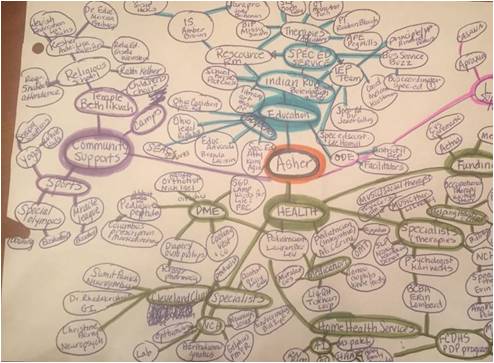
In grad school I learned this neat little thing called a ecomap…and then saw another mom post a personal one in a blog. A year ago, I decided to make one for the kids (for sake of privacy, a fourth of this map is not shown) For us, that means 37 total IEP objectives and 19 ISP service areas to track, 44 providers, 12 clinics and 6 agencies we are in regular contact. All before work and caregiving. When you meet a parent of a child with special needs–and if you run into them somewhere and they don’t seem to recognize you….or you already know one who seems extra high strung or flighty or snarky….well….cut them a little slack. Not everyone is built to keep this much in their head all the time.